Thank you for your feedback!
We will contact you shortly

Free consultation
Enter your phone number and we will call you back for a consultation on any moving and storage services
How to Choose Nationwide Movers for a Long-Distance Move
A long-distance relocation involves more than loading boxes onto a truck. When your belongings travel hundreds or thousands of miles, you need a moving company capable of coordinating transportation, protecting your shipment, meeting federal requirements, and keeping you informed throughout the journey.



Nationwide movers handle relocations across multiple states and may provide packing, storage, vehicle shipping, specialty-item handling, and commercial moving services. However, service quality, pricing, and protection options can vary significantly between companies.
This guide explains how nationwide moving companies operate, what services they offer, how costs are calculated, and what you should verify before signing a moving contract.
What Are Nationwide Movers?
Nationwide movers are moving companies that coordinate relocations across multiple states or throughout the United States. In most cases, a move that crosses a state line is considered an interstate move and is subject to federal regulations.
Unlike a local move, an interstate relocation may involve:
- Federal registration requirements
- Long-distance transportation planning
- Shipment weight or volume calculations
- Delivery windows instead of a single delivery time
- Multiple crews or transportation hubs
- Additional documentation
- Different valuation protection options
The term nationwide mover is not a separate legal classification. Before booking, determine whether the company is an interstate household goods carrier, a moving broker, or a business that provides both services.
Moving Company vs. Moving Broker
A moving company physically transports your belongings using its own or authorized vehicles and moving crews. A broker arranges transportation with another moving company and may not own trucks or employ the crew completing your move.
Both interstate movers and moving brokers must be registered with the Federal Motor Carrier Safety Administration. You can check a company’s registration, operating authority, contact details, and complaint information through FMCSA Protect Your Move.
Ask the company directly:
- Are you the carrier that will transport my shipment?
- Will another moving company handle any part of the move?
- What is the carrier’s legal name and USDOT number?
- Who should I contact if the schedule changes?
- Who is responsible for damage or loss claims?
Why Choose Nationwide Movers?
A qualified nationwide mover can simplify the coordination required for an interstate relocation. Instead of arranging transportation, labor, packing, storage, and specialty services separately, customers can manage the move through one provider.
Experience With Interstate Logistics
Long-distance moves require careful planning because travel time, delivery access, shipment size, weather, and federal transportation rules can affect the schedule.
Experienced long-distance movers can help coordinate:
- Pickup and delivery windows
- Inventory preparation
- Route planning
- Building access requirements
- Packing and loading
- Temporary storage
- Shipment updates
- Delivery and final inventory checks
A Wider Range of Moving Services
Nationwide moving companies may offer more services than small local crews, although availability should always be confirmed before booking.
Common services include:
- Residential moving
- Apartment and household relocations
- Full or partial packing
- Furniture disassembly and reassembly
- Short-term and long-term storage
- Commercial relocation
- Piano and specialty-item moving
- Car shipping
- Loading and unloading
- Packing material delivery
Customers who want additional help can combine transportation with professional packing and unpacking services.
One Point of Contact
A nationwide move may involve several stages, but a professional coordinator can provide one primary contact for scheduling, documentation, shipment updates, and delivery questions.
Before booking, ask whether the company provides a dedicated moving coordinator and how you will receive updates during transportation.
Services Offered by Nationwide Moving Companies
The exact service package depends on the moving company, route, shipment, and destination.
Residential Moving
Residential moving services may include:
- In-home or virtual inventory assessment
- Packing and labeling
- Protection for furniture and appliances
- Loading and transportation
- Furniture placement at the destination
- Unpacking and debris removal
- Storage between pickup and delivery
Confirm which services are included in the estimate. Packing, storage, bulky-item handling, and additional labor may be charged separately.
Commercial Relocation
Business moves require careful scheduling to reduce operational disruption. Commercial relocation services may cover:
- Office furniture and equipment
- Computers and IT infrastructure
- Files and business records
- Warehousing and inventory
- Employee workstations
- After-hours or weekend moving
- Staged department relocation

Businesses should request a written relocation plan that identifies responsibilities, priority items, access requirements, and the order in which departments will be moved.
Specialty Moving Services
Some nationwide movers can arrange transportation for items that require additional equipment or preparation, including:
- Pianos
- Antiques
- Artwork
- Safes
- Pool tables
- Large appliances
- Vehicles
- Fragile or high-value collections
Do not assume that specialty handling is included in a standard estimate. Disclose these items during the initial survey and request written confirmation of any additional fees.
How to Verify a Nationwide Mover
Choosing a mover should involve more than comparing online ratings. Take time to verify the company’s identity, registration, estimate, documentation, and claims process.
1. Check the USDOT Number
Interstate movers must have a USDOT number and appropriate federal operating authority. Verify that the legal business name, address, telephone number, and website match the information provided by the company.
A USDOT number alone does not guarantee excellent service, but inconsistent or missing registration information is a serious warning sign.
2. Confirm Whether You Are Hiring a Mover or Broker
The company’s website and estimate should clearly explain whether it will transport the shipment or arrange the move through another carrier.
If the company is a broker, ask for:
- The name of the assigned carrier
- The carrier’s USDOT number
- A list of carriers used by the broker
- An explanation of who handles payments and claims
- Written confirmation of the final service provider
3. Request a Detailed Written Estimate
Do not rely on a price provided only by telephone. The mover should evaluate your shipment and issue a written estimate describing the expected charges and services.
Review whether the estimate includes:
- Complete household inventory
- Packing materials and labor
- Transportation charges
- Furniture assembly
- Stairs or elevator access
- Long-carry services
- Shuttle service
- Storage
- Specialty items
- Valuation protection
- Possible additional charges
Tell the mover about everything being transported. Adding items or requesting additional services after the estimate is prepared can change the final price.
4. Understand the Type of Estimate
Interstate moves may use binding or non-binding estimates.
| Estimate type | What it means |
|---|---|
| Binding estimate | The listed price generally applies to the items and services included in the written estimate |
| Non-binding estimate | The final charge may change based on the actual shipment weight and services provided |
| Binding not-to-exceed estimate | The customer generally pays the estimated amount or the lower actual charge, depending on the agreement |
Read the estimate carefully and never sign incomplete or blank documents.
5. Review the Bill of Lading and Inventory
The bill of lading is the contract between you and the moving company. It should identify the mover, services, payment terms, pickup details, delivery conditions, and valuation selection.
The mover should also prepare an inventory describing the items being transported and noting visible damage where applicable. Review the inventory before signing and keep copies of all documents until the move and any claims are resolved.
Valuation Protection and Moving Insurance
Valuation protection and moving insurance are not the same thing.
For interstate household moves, federal rules require movers to offer two primary levels of liability: Full Value Protection and Released Value.
Full Value Protection
Under Full Value Protection, the mover may choose to repair a damaged item, replace it with a similar item, or provide a cash settlement based on the applicable replacement value and contract terms.
The cost and deductible options vary by mover. Items worth more than $100 per pound may need to be specifically declared in the shipping documents.
Released Value Protection
Released Value is provided at no additional charge but offers minimal protection. The mover’s liability is limited to $0.60 per pound per item.
For example, if a 20-pound television is lost or damaged, the maximum compensation under Released Value may be only $12, regardless of the television’s purchase price.
Third-Party Insurance
Some customers purchase separate moving insurance from a third-party insurer. This is different from the valuation protection provided by the mover and may be regulated under state insurance laws.
Before selecting protection:
- Read the mover’s valuation terms
- Ask about deductibles
- Declare high-value items
- Check exclusions and claim deadlines
- Review your homeowners or renters insurance
- Keep photographs, receipts, and serial numbers
The FMCSA liability and protection guide provides additional information about these options.
How Much Do Nationwide Movers Cost?
The cost of a nationwide move depends on the shipment and services rather than distance alone.
Major pricing factors include:
- Distance between the locations
- Shipment weight or volume
- Number and type of belongings
- Packing and unpacking services
- Moving date and season
- Origin and destination access
- Stairs, elevators, and long carries
- Storage requirements
- Shuttle service
- Specialty or oversized items
- Selected valuation protection
- Expedited or exclusive transportation
Moving during summer, on weekends, or near the end of the month may cost more because demand is typically higher.
Use the moving cost calculator to prepare an initial budget, but request a written estimate before making a final decision.
Local vs. Nationwide Movers
The right company depends on the distance and complexity of the move.
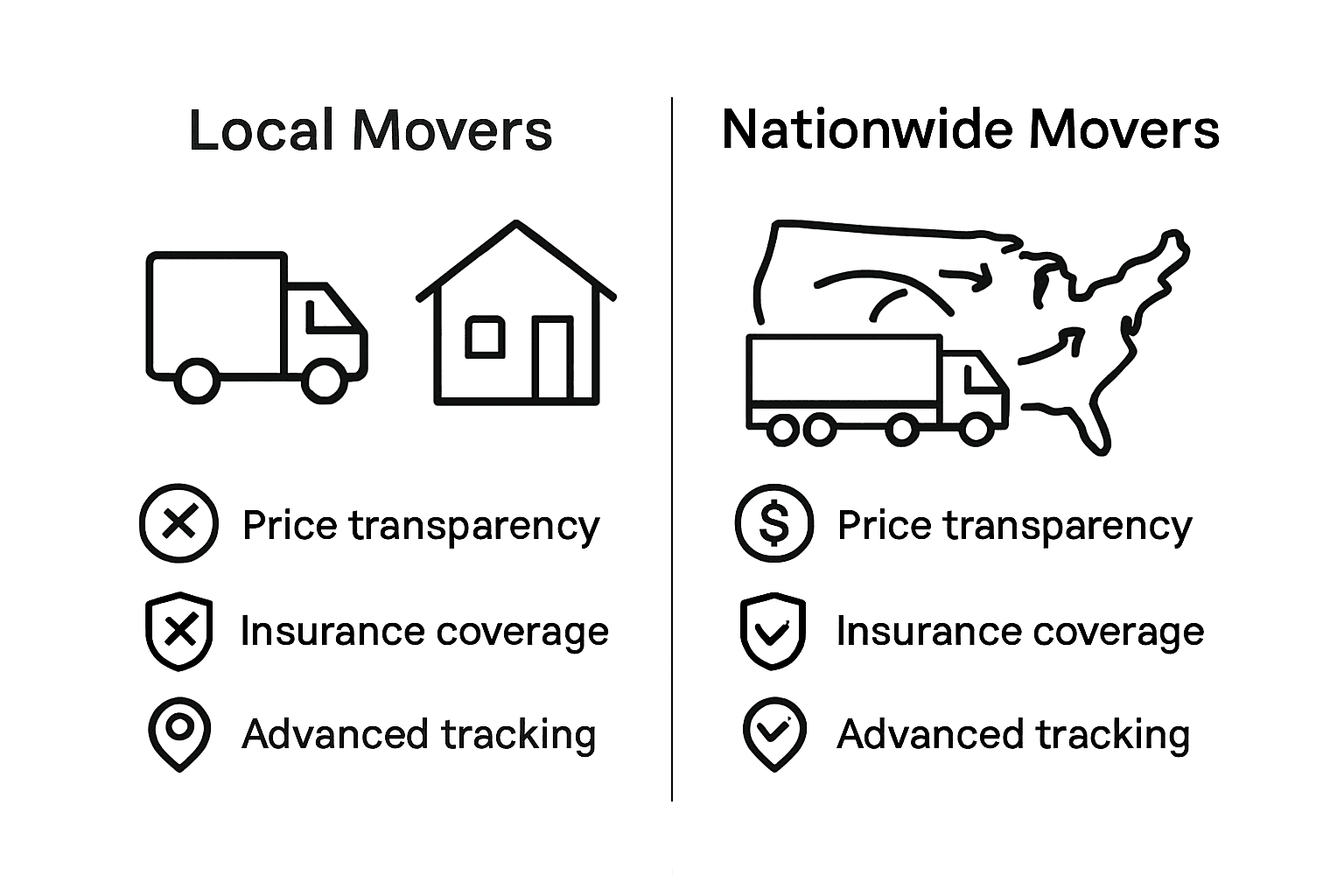
| Criteria | Local movers | Nationwide or interstate movers |
|---|---|---|
| Typical service area | City, county, or nearby region | Multiple states or nationwide routes |
| Primary regulation | State and local requirements | Federal and applicable state requirements |
| Common pricing method | Often hourly | Often based on weight, distance, and services |
| Delivery schedule | Frequently completed in one day | May involve a delivery window |
| Storage options | Depends on the company | Often available as part of a larger network |
| Best suited for | Short-distance relocations | Interstate and cross-country moves |
These are general differences. Pricing, tracking, protection, and specialty services vary between individual moving companies.
Warning Signs of a Moving Scam
Be cautious if a moving company:
- Refuses to provide its legal name or USDOT number
- Offers a price without reviewing your inventory
- Demands a large cash deposit
- Provides only a verbal estimate
- Uses documents containing blank sections
- Cannot explain whether it is a mover or broker
- Has registration details that do not match its website
- Promises unusually low prices compared with other estimates
- Does not provide information about valuation protection
- Changes the price substantially before loading without explanation
- Has no clear physical address or claims procedure
A low estimate does not always mean a low final price. Compare the inventory, services, fees, valuation selection, and estimate type instead of looking only at the total.
Questions to Ask Before Booking Nationwide Movers
Before signing a contract, ask:
- Are you a carrier, broker, or both?
- What are your USDOT and MC numbers?
- Will another company handle my shipment?
- Is the estimate binding or non-binding?
- Which services are included in the price?
- What additional fees could apply?
- What delivery window should I expect?
- How will I receive shipment updates?
- What valuation protection options are available?
- How are damage and loss claims submitted?
- Do you provide storage if the destination is unavailable?
- Who should I contact during pickup and delivery?
Write down the answers and make sure important promises appear in the contract.
Plan Your Move With Star Van Lines Movers
Choosing nationwide movers requires careful research, but the right company can make a long-distance relocation more organized and predictable.
Star Van Lines Movers provides interstate moving, packing, storage, commercial relocation, and specialty moving solutions. Our team can help evaluate your shipment, explain available services, and prepare a detailed moving plan based on your route and schedule.
Start with the moving cost calculator or request a personalized quote for your upcoming relocation.
Frequently Asked Questions
What is a nationwide moving company?
A nationwide moving company provides relocation services across multiple states or throughout the United States. Interstate household goods carriers must meet applicable federal registration and consumer protection requirements.
How can I check whether a nationwide mover is legitimate?
Request the company’s legal name and USDOT number, then verify the information through FMCSA. Make sure the address, telephone number, website, and operating status match the company you are considering.
Is a moving broker the same as a moving company?
No. A moving company physically transports your belongings, while a broker arranges transportation with a carrier. Ask who will complete the move and verify the assigned carrier before pickup.
How are nationwide moving costs calculated?
Costs may depend on shipment weight or volume, distance, moving date, packing, storage, access conditions, specialty items, and valuation protection. A complete inventory is necessary for a more accurate estimate.
Are my belongings automatically insured during a move?
Movers provide valuation protection, which is not the same as a standard insurance policy. Interstate movers must offer Full Value Protection and Released Value, while separate insurance may be available from a third-party provider.
How many moving estimates should I compare?
It is sensible to compare several written estimates. Review the inventory, services, fees, estimate type, valuation option, and delivery conditions rather than choosing a company solely because it offers the lowest total.
Recommended


Artur Shakhnazarov
PR Manager
Love Doing PR for my Company