
Thank you for your feedback!
We will contact you shortly

Free consultation
Enter your phone number and we will call you back for a consultation on any moving and storage services
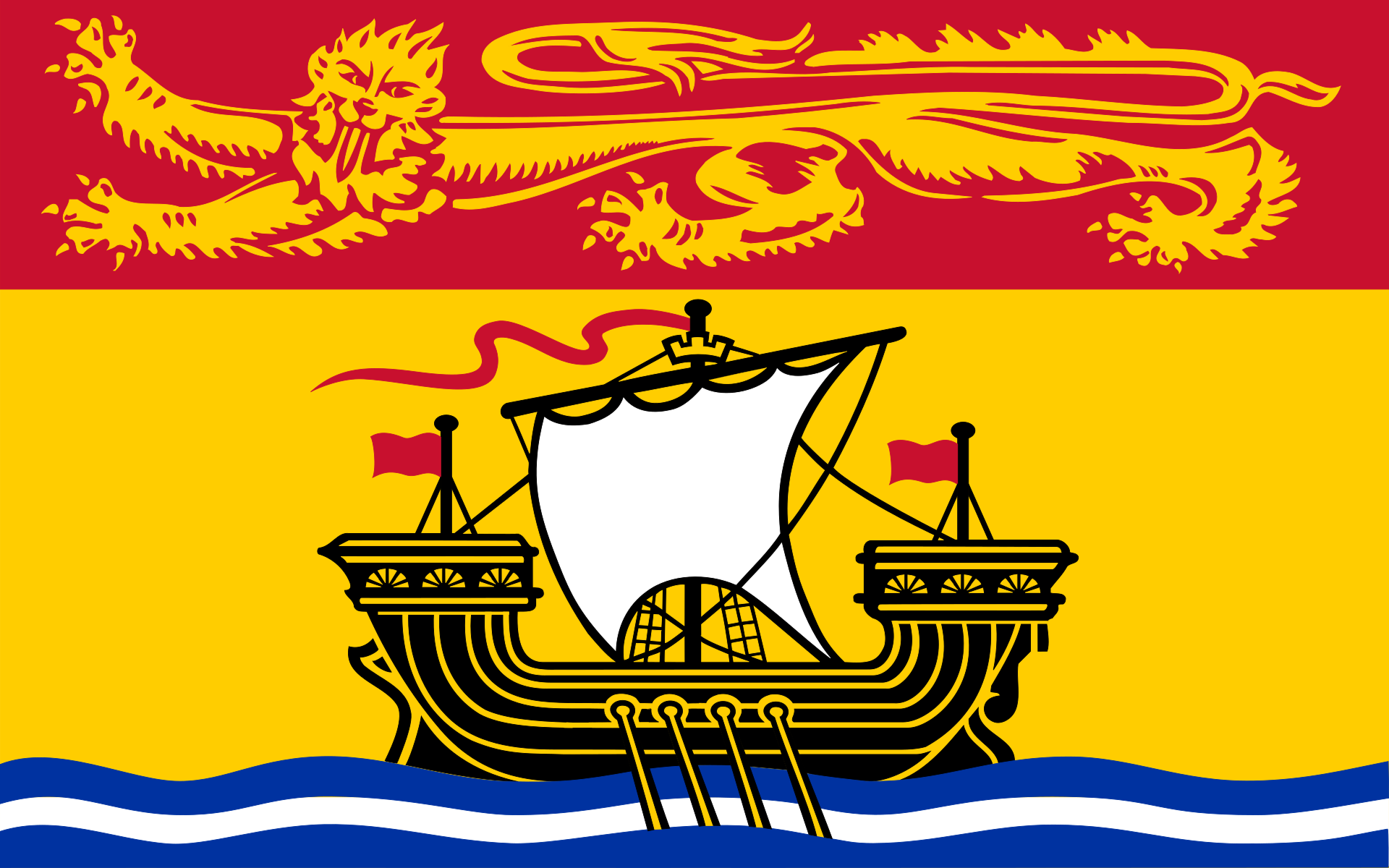
New Brunswick
Moving to New Brunswick, Canada from the US
New Brunswick, Canada is the country's only officially bilingual province, according to the province's Office of the Commissioner of Official Languages. That's because the Charter of Rights and Freedoms makes English and French its official languages, with equal status in every institution of the provincial legislature and government. Section 20(2) of the Charter brings that down to the service counter: any member of the public may communicate with any provincial government office in English or French and receive its available services in either. So what changes for a family coming from the US? New Brunswick Medicare, the province's health coverage, your licence and your car's registration can all be handled in English. And the 2021 Census shows how present French is: 30.3% of the province was French-speaking and 34.0% spoke both languages.
We move households from the US to New Brunswick, starting with a survey that measures your shipment in cubic feet and a written estimate built on that volume. Our authority for the US road leg is a matter of public record: USDOT #4176875 and MC #1607491.
Moving to New Brunswick from the US happens in two stages. At the border, the Canada Border Services Agency (CBSA) decides if you count as a settler, a status that leaves out work of 36 months or less and study, and records your belongings. Then the province takes over, with Medicare, a New Brunswick driver's licence and car registration.
To book the survey, call (855) 822-2722. Star Van Lines has been moving households since 2016, in every one of the 50 states, and counts 240+ reviews across public platforms.

Dennis has 15+ years of experience in interstate moving and has coordinated over 1,000 relocations across the United States.
Moving services to New Brunswick
We move households from the US to New Brunswick in a set order: a survey, a written estimate, a valued inventory at loading, then the US road leg under our federal authority. Before you reach the border, we'll explain in plain English what CBSA asks of a settler.
How does a New Brunswick move start?
With a survey, in your home or over video, that measures everything you're sending in cubic feet. The written estimate is built from that figure rather than a phone guess. Each item is listed and valued at loading. And that inventory doubles as the record you'll lean on for customs.
The US road leg runs under authority from the Federal Motor Carrier Safety Administration, and it's yours to check. Type #4176875 into the SAFER registry and you'll see the USDOT number marked active, MC #1607491 on the same record and household goods named in the authority. But once your goods are in Canada, the rules belong to CBSA and New Brunswick's own departments.
Which Maine crossings lead into New Brunswick?
Several do, and CBSA's office directory lists their hours. Two are Designated Commercial Offices, which CBSA defines as ports giving 24-hour, seven-day service for reporting and clearing commercial goods:
- St Stephen 3rd Bridge, facing Calais, with traveller and commercial service 24 hours a day, seven days a week.
- Woodstock Road in Belleville, facing Houlton, on that same schedule.
Edmundston, opposite Madawaska, is open to travellers around the clock. But its commercial hours are 08:00 to 16:00, Monday to Friday, holidays excepted. CBSA's wait-time page covers what the agency calls 30 of Canada's busiest land crossings from the US. Four of them are in New Brunswick: Edmundston, Woodstock Road, St Stephen 3rd Bridge and the Ferry Point Bridge, where the directory lists hours for travellers only.
These are office hours, not a route plan. When household goods come in on a commercial truck, CBSA gives two ways to clear them: at the first port of arrival, or in bond at a designated CBSA office further on. CBSA's highway memorandum says that office should be contacted beforehand to confirm it can clear settlers' effects.
New Brunswick runs on Atlantic Time, like Nova Scotia and Prince Edward Island, so the province asks drivers arriving from Maine to set their watches one hour ahead. Loading in Maine? Start with our Maine moving page.
How long does a New Brunswick move take?
Your belongings are usually delivered within about 30 days of pickup on a move to New Brunswick, a figure that's typical rather than promised. A border sits in the middle of the trip, with agencies on both sides working to their own schedules.
What if your New Brunswick address isn't set?
Then the goods can wait. Until you confirm the address, they stay where we picked them up, with storage priced by volume.
How much does moving to New Brunswick cost?
What a New Brunswick move costs comes down to the volume you're sending, where in the US it starts and whether you'd like packing done. It's priced the way our other moves are, with only the route logistics differing, and the figure comes as a written estimate after the survey.
Which factors set a New Brunswick price?
- Volume, the cubic feet the survey records.
- Starting point. Loading in Florida makes a longer US road leg than loading in Maine.
- Packing before the goods leave your US home, if you'd rather not do it yourself: the packing and unpacking page has the details.
What do agencies charge for a car?
A car comes with agency charges, separate from any moving estimate:
- CAN$325.00 plus GST/HST, the Registrar of Imported Vehicles fee to declare a car under 15 years old;
- CAN$100 in excise tax if the car has air conditioning, as CBSA's vehicle memorandum lists.
A separate measure, Customs Notice 25-15, has charged a 25% surtax on motor vehicles of US origin, both new and used, from April 9, 2025. But Chapter 98 of the tariff is carved out, apart from the items Schedule 2 names, and 9807.00.00, the settlers' effects item, isn't among them. Cars entitled to CUSMA (Canada-United States-Mexico Agreement) tariff treatment are surtaxed on 85% of the value for duty by default. Classification of the car rests with CBSA.
How do you get the written estimate?
Phone (855) 822-2722 between 08:00 and 20:00, any day of the week. We'll set a date for the survey, in your home or by video, and the estimate arrives in writing. Starting on the West Coast or in the South? The long-distance moving page covers that kind of cross-country haul.
Moving to New Brunswick: what you should know
Getting your goods, car and pets into Canada follows federal rules that don't change with the province, and our Canada moving guide collects them. New Brunswick's part comes after you arrive: Medicare, a licence, car registration and a 15% vehicle tax with exemptions.
Who brings household goods in duty-free?
A settler, as CBSA uses the word: someone entering Canada to set up a residence there for the first time, meaning to stay at least a year. The Definition of Settler Regulations carve out two groups, anyone coming for a job lasting 36 months or less and anyone coming to study, so if either fits you, ask CBSA how your belongings will be handled. For goods to enter duty- and tax-free, a settler must have owned, possessed and used them abroad before arriving. Anything leased is another matter: CBSA doesn't see you as its owner, so duty and taxes apply.
Prepare two copies of a list of everything you're bringing, giving each item's value and, where relevant, its make, model and serial number. Hand it to the border services officer at your first point of entry, even if none of your goods travel with you. From it, the officer completes Form BSF186, the Personal Effects Accounting Document; keep your copy, because it's how you claim anything that arrives later. CBSA lets you fill in BSF186 before you travel, and its moving to Canada page sets out the main conditions. And one rule catches people later: sell or give away an item within 12 months of importing it, and the duty and taxes it was spared come due.
Immigration status is a separate matter for Immigration, Refugees and Citizenship Canada (IRCC), not customs. IRCC says it manages the selection, settlement and integration of newcomers, and no moving company plays a part in that.
Can more boxes follow you to Canada?
Yes, as goods to follow, and they enter duty- and tax-free only if they were on the list you gave the officer on arrival. No deadline for them appears in the Customs Tariff, and CBSA can confirm how that applies to you. Not so alcohol, tobacco or vaping products: those qualify only if you bring them across yourself.
What does CBSA check at the Maine border?
- Alcohol and tobacco. The settler allowance covers 50 cigars, 200 cigarettes, 200 tobacco sticks and 200 grams of manufactured tobacco, plus either 1.5 litres of wine or 1.14 litres of any alcoholic beverages. All of it has to cross with you. Entering New Brunswick from Maine, the minimum age to bring alcohol is 19, because CBSA uses the age of the province or territory of entry, which is 18 only in Alberta, Manitoba and Quebec. CBSA's I Declare page sets 18 for tobacco and vaping products under a personal exemption.
- Firearms. Each one is declared to CBSA on arrival, and residents need a Possession and Acquisition Licence to import non-restricted firearms.
- Cannabis. Health Canada is clear that carrying it across the border is illegal, medical cannabis included.
- Food, plants and firewood. Declare all food, plants and animal products, and get a permit for firewood; vehicles, equipment or footwear carrying soil are usually turned back.
- Used mattresses normally need a cleaning and fumigation certificate from the country of export, but not as settlers' effects under 9807.00.00.
- Cash. Report CAN$10,000 or more in currency or monetary instruments when you arrive.
Bringing a car into New Brunswick
The US export paperwork comes first. Under 19 CFR 192.2, US Customs and Border Protection (CBP) must have the export documents at least 72 hours before a car leaves by road. Where a lender holds a recorded lien on the car, or it's leased, CBP also needs that third party's written go-ahead. Electronic Export Information is filed for any used car, whatever its value (15 CFR 30.2), with the filing citation due to CBP at least 72 hours before export under 15 CFR 30.4.
Then comes the Registrar of Imported Vehicles (RIV), whose program takes a car that:
- is less than 15 years old on the date of import;
- isn't flagged inadmissible on the Vehicle Import Compatibility List;
- has no outstanding manufacturer safety recalls;
- comes with its original US title.
The car is declared on the Vehicle Import Form, Form 1. RIV gives you 45 days from import to complete its inspection, and a delinquency notice follows if you don't. A car financed in the US meets CBSA's settler ownership test, but a leased one doesn't.
New Brunswick's own rules follow. A new resident must register the vehicle with Service New Brunswick immediately, bringing the Vehicle Import Form if the car was imported into Canada, and no plate is issued without insurance for that specific vehicle. A car last registered outside New Brunswick must then be inspected within 14 days of registration. Stickers stopped on April 1, 2026, though registration is still renewed every year.
And there's tax: 15% on vehicles, as harmonized sales tax (HST) or as the Provincial Vehicle Tax, with exemptions. The Provincial Vehicle Tax doesn't apply to a vehicle bought outside Canada; for the HST on one, the province points you to the Canada Revenue Agency. Where the Provincial Vehicle Tax would apply, section 17 of the Harmonized Sales Tax Act waives it for a vehicle you bring in for personal use when setting up residence. To qualify, you must have lived outside the province for at least 183 consecutive days and owned the vehicle for more than 30 days. Service New Brunswick applies it at registration on your previous registration and a Declaration for Settler's Effects form.
Dogs and cats crossing from Maine
The pet tool of the Canadian Food Inspection Agency (CFIA) lists the United States apart from its rabies-free countries, so:
- Cats 3 months or older need a valid rabies vaccination certificate.
- Dogs older than 3 months need one too, from a vaccine given at 3 months of age or later.
- Puppies past 3 months but not yet 8 months old, if they come without their owner, also need a Veterinary Certificate of Health.
- Microchips and tattoos aren't required.
Does the 2026 surtax touch settlers' effects?
Since September 8, 2026, Customs Notice 26-23 has put a surtax on certain goods of US origin at one of three rates: 15%, 25% or 50% of the value for duty. Exempt from it are goods in Chapters 98 and 99, except items Schedule 4 names, and Schedule 4 doesn't name 9807.00.00, the settlers' effects item. Classification is still CBSA's call.
First weeks in New Brunswick: a checklist
- Apply for Medicare after you've moved. Applications are accepted only once you've physically moved, online or, if you can't apply online, on a PDF form. Arriving from another country, you may be entitled to Medicare coverage from your first day in the province, if you meet the eligibility requirements and Medicare accepts that you've established a permanent residence in the province. A letter then confirms your start date. Forms are on the Medicare application page.
- Collect the documents. Proof of Canadian citizenship or copies of all your Canadian immigration records, the last entry stamp in each passport if any, proof of identity and proof of New Brunswick residency, such as a lease, a utility bill or an employment confirmation. A child aged 19 or older needs an application of their own.
- Know where Form I-407 fits. Before coverage, Medicare must be satisfied that you don't have, or don't intend to keep, permanent resident status in another country. A US green card holder can give that status up and show an official document such as US Form I-407 (Option A). Or they can provide an annual CBSA Travel History Report showing the residency requirements were met over the previous 12 months (Option B). Neither is a step for US citizens.
- Exchange your licence as soon as you take up residence. A US licence goes class for class without a driver's test or a medical if it doesn't expire within the next six months and the other conditions are met. Students may keep theirs while in school, until they take up permanent residence or get a job. Temporary residents with a work or study permit valid for more than 6 months may use their home licence for up to 6 months after landing.
- Insure and register the car, then have it inspected within 14 days of registration.
- Know the taxes. The Canada Revenue Agency lists New Brunswick's HST at 15%. For 2026, the lowest provincial income tax rate is 9.4% on the first CAN$52,333 of taxable income, on top of federal tax, and the provincial rate is set by where you live on December 31, 2026.
What to know before moving to New Brunswick
New Brunswick by the numbers
0,522
Population, July 1, 2026 (preliminary)
0,143
Moncton metro area, July 1, 2025 (preliminary)
0.3%
French-speaking residents, 2021 Census
0.0%
Bilingual in English and French, 2021 Census
0%
Harmonized sales tax rate, 2026
CAN$0,453
Average two-bedroom rent, Moncton, October 2025
Statistics Canada's preliminary estimate put New Brunswick's population at 883,522 on July 1, 2026, and Moncton is the largest of its metro areas. Language sets the province apart: in the 2021 Census, 30.3% of residents were French-speaking and 34.0% were bilingual in English and French.
Is New Brunswick a good place to live?
Living in New Brunswick means two official languages, three metro areas and winters with real snow. Moncton is the biggest, ahead of Saint John and Fredericton, and the Canada Mortgage and Housing Corporation (CMHC) put the average two-bedroom rent in the three between CAN$1,290 and CAN$1,453 a month in October 2025.
How bilingual is New Brunswick?
In its legislature and government, fully. The province passed its first Official Languages Act on April 18, 1969, naming English and French its two official languages, and a broader act in 2002 created the Commissioner of Official Languages and the active offer of service. Section 16.1 of the Charter gives the English and French communities equal status, including distinct educational and cultural institutions. Canadian Heritage's 2021 Census figures count 30.3% of the province as French-speaking, 69.5% as English-speaking and 34.0% as bilingual.
Moncton, Saint John or Fredericton?
Statistics Canada's preliminary estimates for July 1, 2025 give the Moncton metro area 196,143 people, with Saint John at 144,543 and Fredericton at 125,303. In October 2025, CMHC's survey found an average two-bedroom rent of CAN$1,453 in Moncton, CAN$1,413 in Fredericton and CAN$1,290 in Saint John, with vacancy rates of 3.9%, 2.5% and 1.9%.
Rent increases are capped. Landlords can't raise rent by more than 3% every 12 months, must give six months' written notice and can't raise it at all in the first 12 months of a tenancy. But they may apply for permission to go up to 9% for justified capital spending on renovations. And on June 24, 2026, the province said it's keeping the three per cent cap for the 2027 calendar year.
How snowy and cold is New Brunswick?
Cold, and snowy in Moncton. Environment and Climate Change Canada's 1991-2020 normals give an average January temperature of -9.2 °C in Fredericton, -8.4 °C in Moncton and -7.9 °C in Saint John. Moncton's snowfall averages 309.9 cm in a year, against 214.8 cm in Saint John. July averages are 19.7 °C in Fredericton, 19.3 °C in Moncton and 17.3 °C in Saint John. And on the coast, Parks Canada says the Bay of Fundy at Fundy National Park has the world's highest tides, with waters rising up to 12 m or more.
Which industries drive New Brunswick?
The provincial government calls New Brunswick the largest exporter of mineral products in the Maritimes and the largest of Canada's three Maritime provinces. Forestry, fishing, construction, manufacturing and food services are among the sectors it lists. The 2026-27 budget projects real GDP growth of one per cent in 2026.
To plan a move to New Brunswick, Canada, call (855) 822-2722 and book the survey; the written estimate follows. USDOT #4176875 and MC #1607491 cover the road leg through the US, the Canada moving guide holds the rules every province shares, and our international moving page covers moves to other countries.
FAQ
Questions? Look here
Can’t find an answer? Call us
(855) 822-2722 or email
Yes. Section 20(2) of the Canadian Charter of Rights and Freedoms lets any member of the public in New Brunswick communicate with any office of the provincial legislature or government, and receive its available services, in English or French. New Brunswick's Office of the Commissioner of Official Languages calls it Canada's only officially bilingual province.
Yes. We serve all 13 provinces and territories, New Brunswick among them. A survey measures the shipment in cubic feet, the price comes back as a written estimate, and the US road leg runs under USDOT #4176875 and MC #1607491. The number to ring for a survey is (855) 822-2722.
They can be, if CBSA treats you as a settler and the goods were owned, possessed and used before you arrived and aren't leased. Coming to Canada for study, or for a job lasting 36 months or less, falls outside the settler definition. Selling or giving away an item within 12 months of import ends its exemption.
Medicare says people moving to New Brunswick after living in another country may be entitled to Medicare coverage from their first day of arrival, if they meet the eligibility requirements and Medicare accepts that they've established a permanent residence. It must also be satisfied that they don't hold or intend to keep permanent resident status elsewhere, and it accepts applications only after the physical move.
No. Option A, giving up permanent resident status held in another country and showing a document such as US Form I-407, is for people who hold that status, US green card holders for example. Their Option B is an annual CBSA Travel History Report covering the previous 12 months. Medicare doesn't present either as a step for US citizens.
Yes, class for class, without a driver's test or a medical, as long as the licence won't expire within the next six months. You apply, pay the fee, prove identity and residency, surrender the old licence where possible and must be 16 or older, with parental consent under 18. The switch is due as soon as you take up residence.
Immediately after you become a resident, with Service New Brunswick and with insurance for that vehicle; a car imported into Canada also needs its Vehicle Import Form. A car last registered outside the province then has to be inspected within 14 days of New Brunswick registration.
CBSA's office directory gives that status to St Stephen 3rd Bridge, opposite Calais, and Woodstock Road in Belleville, opposite Houlton. CBSA defines a Designated Commercial Office as giving 24-hour, seven-day service for reporting and clearing commercial goods. Edmundston takes commercial traffic on weekdays from 08:00 to 16:00, except holidays.
Yes, with a valid rabies vaccination certificate. The CFIA keeps the United States off its list of rabies-free countries, so cats from 3 months and dogs over 3 months need one. Dogs older than 3 months but under 8 months that travel without their owner need a Veterinary Certificate of Health as well.
The volume in cubic feet, your US starting point and any packing you want set the price. The survey sets the volume, and the price comes back as a written estimate. Call (855) 822-2722 to book one.
Ready to Start Your New Brunswick Move?
Get a free moving estimate today. No obligation, no pressure.
Call us or fill out the form - we'll get back to you fast.
USDOT #4176875 | MC #1607491