
Thank you for your feedback!
We will contact you shortly

Free consultation
Enter your phone number and we will call you back for a consultation on any moving and storage services
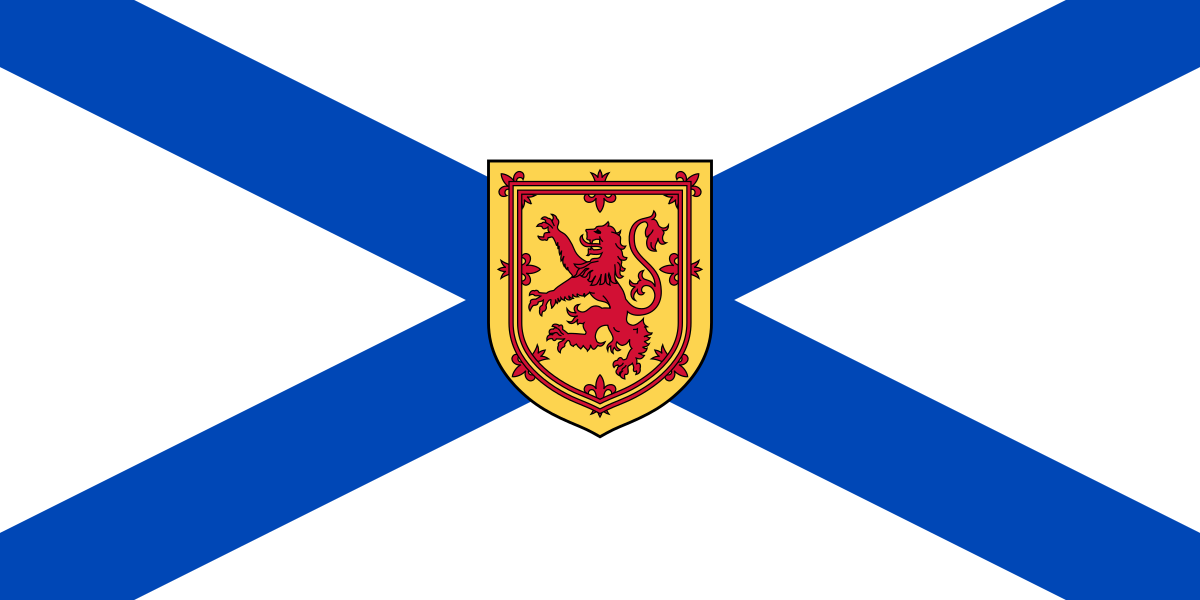
Nova Scotia
Moving to Nova Scotia from the US
Moving to Nova Scotia from the US asks less of you on paper than most people brace for. The province says Health Card coverage usually starts on the date you become a resident of Nova Scotia when the move is from outside Canada, for a Canadian citizen or permanent resident who meets its eligibility rules. That other rule you've read about, where cover begins on the first day of the third month, is written for arrivals from another Canadian province or territory. A valid US licence is usually exchanged for a Nova Scotia one of the same class with no testing. And the harmonized sales tax here came down to 14% on April 1, 2025.
Star Van Lines handles the American road leg under our federal operating authority, USDOT #4176875 with MC #1607491. We'll survey your home in person or by video, measure the shipment in cubic feet, and that figure goes into a written estimate. Here's what follows: how the border agency treats a new resident's goods, what a car and a pet need, and which provincial offices want to hear from you first.
A US-to-Nova-Scotia move is a household move with a customs entry in the middle, followed by a short list of provincial errands: a Health Card, a licence exchange, an inspection for the car. The water in the photographs is the easy part.
Want a figure? Call (855) 822-2722 and we'll arrange the survey and send the estimate in writing. Since 2016 Star Van Lines has moved households in all 50 states, and the review history across public platforms runs past 240.

Dennis has 15+ years of experience in interstate moving and has coordinated over 1,000 relocations across the United States.
Moving services to Nova Scotia
A move to Nova Scotia from the US runs on two legs and one border. Everything up to the crossing sits under a US federal moving authority you can look up yourself. Past it Canadian rules govern, and Nova Scotia shares no land border with the United States at all.
How does a move to Nova Scotia work?
It begins with a survey. We walk your home in person or by video and measure what's shipping in cubic feet, and that volume turns into a written estimate rather than a number guessed over the phone. The shipment is inventoried and valued at loading, item by item.
And CBSA advises new residents to prepare their own list as well, in two copies, showing value, make, model and serial number wherever those apply. Write yours with our inventory open beside you. We'll talk you through the rest of the paperwork too: which forms Canada asks a settler for, and what needs to be in your hand at the border.
Our own authority from the Federal Motor Carrier Safety Administration covers that American road leg. SAFER lists USDOT #4176875 as active, MC #1607491 against it, and the carrier authorized for household goods, and you can pull both numbers up yourself on the SAFER registry. But it's American road authority, and it ends at the border. From there CBSA and the province's own agencies set the terms.
We take households to every Canadian province and territory, 13 in all, and send the goods by sea where a community has no road. The Canada moving guide shows how they differ.
Which crossings lead toward Nova Scotia?
Nova Scotia doesn't touch the United States. Road access from Maine runs through New Brunswick, and CBSA's directory shows two of the offices on that path open to travellers and commercial traffic 7 days a week, 24 hours:
- St. Stephen 3rd Bridge, St. Stephen, New Brunswick, across from Calais, Maine. CBSA marks it a Designated Commercial Office, and it also appears on the agency's wait-time list of the 30 busiest land crossings from the United States, with a commercial flow.
- Woodstock Road, Belleville, New Brunswick, across from Houlton, Maine, with the same round-the-clock hours.
Office hours can change, so read CBSA's page for your crossing close to the date. Loading in Massachusetts? The road north goes through Maine either way.
Is there a ferry from Maine?
There is, for part of the year, and it carries people rather than freight. Bay Ferries runs The CAT between Bar Harbor, Maine and Yarmouth, Nova Scotia, from May 14 to October 14 in the 2026 season. But it's a high-speed car ferry for passengers and their own vehicles, not a freight service, so read it as a way to arrive yourself rather than a route for a household shipment.
How long does a move here take?
Most moves are delivered within about 30 days of pickup. A border stands between the American road leg and your new address, with two sets of agencies, so that figure is typical rather than promised. You also get the estimate in writing, plus a US operating authority anyone can check in a public database.
Loading before the Nova Scotia address is known?
Then your belongings stay at the pickup end until you confirm it, and storage is billed by volume.
How much does moving to Nova Scotia cost?
What a move to Nova Scotia costs depends on how much you ship and where the load starts. There's no published rate card for Canada that we could read a number off. Each move is priced after a survey and set out in writing, so the figure follows your volume and your starting point.
What changes the price to Nova Scotia?
- Volume. The survey measures it room by room, in cubic feet.
- Starting point. A load leaving Portland and one leaving Houston aren't the same American road leg.
- Packing. Hand the crockery and the bookshelves over instead, through our packing and unpacking service.
A car carries its own import bill, and that bill isn't ours. For the Vehicle Import Form declaration on a car less than 15 years old the Registrar of Imported Vehicles charges CAN$325.00 plus GST/HST, and an imported vehicle fitted with air conditioning owes a CAN$100 excise tax. The provincial inspection comes later, through the Registry of Motor Vehicles.
How do you get a Nova Scotia estimate?
Call (855) 822-2722. Someone answers seven days a week, 08:00 to 20:00. The survey, the measurements and the written estimate follow from there. If the move starts a long way from the Atlantic coast, our long-distance moving page explains how the domestic road leg is handled.
Moving to Nova Scotia: what you should know
Canada's border agency calls you a settler when you enter to establish a residence for the first time, for a year or more. Settlers can bring personal and household effects in without duty or taxes when the agency's conditions are satisfied. Arriving to work for 36 months or less, or to study? Different rules apply to you.
What does CBSA count as settlers' effects?
CBSA says you must have owned, possessed and used the goods abroad before you arrive for them to enter duty- and tax-free. But leased goods fall outside it, because the agency doesn't regard you as their owner.
Prepare two copies of a list of everything you're bringing, with value, make, model and serial number wherever those apply. Hand it to the officer at your first point of entry, even when the shipment is still behind you. From the list the officer completes Form BSF186, the Personal Effects Accounting Document, and your copy claims the goods that turn up later. CBSA says the form can be filled in ahead of arrival, and it publishes Form BSF186A for the list itself, with anything still to come in its own section. CBSA keeps the full rules on its moving to Canada page.
One condition trips people up. The settler declaration commits you to notify CBSA and pay the duties owing if you dispose of an item in Canada within 12 months of importing it. CBSA adds that goods sold or given away within one year of importation become subject to the duty and taxes originally exempted.
What can reach you later?
Anything that reaches Canada after you counts as goods to follow, and it comes in duty- and tax-free only if it appeared on the list you handed over at entry. The settlers' effects memorandum from CBSA sets no time limit on goods listed to follow. Alcohol and tobacco work differently under the tariff: they count as settlers' effects only among the goods accompanying you on arrival. Put any question of timing to CBSA.
What draws a closer look?
- Alcohol and tobacco. Tariff item 9807.00.00 lets a settler include either wine up to 1.5 litres or other alcoholic beverages up to 1.14 litres, plus set tobacco quantities, and only among goods accompanying you on arrival. CBSA ties the minimum age for importing alcohol to the province of entry: 19 outside Alberta, Manitoba and Quebec. For tobacco or vaping products under a personal exemption, 18.
- Firearms. Every firearm gets declared to a border services officer. CBSA leaves a visitor no route to prohibited firearms, devices or weapons, and a Canadian resident importing non-restricted firearms needs a Possession and Acquisition Licence.
- Cannabis. Taking cannabis across the border is illegal, Health Canada says, and that covers cannabis for medical use.
- Food, plants, soil on your boots. Every food item, plant, animal and related product is declared. Firewood needs a permit, and anything carrying soil, whether garden tools, footwear or a vehicle, is usually turned back. A used mattress needs a certificate of cleaning and fumigation in the country of export, though the tariff exempts mattresses brought in as settlers' effects.
- Cash. Carrying CAN$10,000 or more in currency or monetary instruments? Report it on arrival.
Bringing your car to Nova Scotia
Start on the American side. Under 19 CFR 192.2 the required documentation goes to US Customs and Border Protection at least 72 hours before a vehicle leaves by highway, with the vehicle presented at export; under 15 CFR 30.4 the Electronic Export Information filing citation runs on the same 72-hour clock. A leased vehicle, or one carrying a recorded lien, needs a letter from the third party expressly allowing export. RIV advises sending supporting documents to CBP at least 3 business days ahead.
On the Canadian side, a vehicle entering the RIV program has to be less than 15 years old on the date of importation, clear of the Vehicle Import Compatibility List, and free of outstanding manufacturer safety recalls, with an original valid US state certificate of title. The declaration itself goes on Transport Canada's Vehicle Import Form, Form 1, or on a RIV e-Form 1. Miss the inspection inside 45 days from the date of import and RIV issues a delinquent notice. And a car leased in the United States fails the settler ownership requirement, while a financed one meets it.
Then the province. Under the Vehicle Inspection Regulations a vehicle bought or registered outside Nova Scotia that must be registered here goes to an official testing station no later than 30 days after it enters. The Registry of Motor Vehicles puts it the same way: within 30 days of entry and before registration. But a valid certificate from a reciprocating jurisdiction can exempt a vehicle, so ask the Registry which column you sit in.
What do a dog and a cat need?
The Canadian Food Inspection Agency keeps the United States off its list of rabies-free countries, so your pet follows the rules for a country that isn't free of rabies. A valid rabies vaccination certificate is required for a personal pet dog 8 months or older, and equally for one older than 3 months but under 8 months arriving with its owner. Unaccompanied, that younger dog needs a valid Veterinary Certificate of Health too. Cats 3 months or older need the rabies certificate, and a dog must have been at least 3 months old at vaccination. No microchip, no tattoo: CFIA asks for neither on pet dogs or domestic cats.
Does the surtax hit a settler's goods?
CBSA Customs Notice 26-23 put a surtax of 15%, 25% or 50% of the value for duty on certain goods originating in the United States, effective September 8, 2026. Tariff Chapters 98 and 99 are exempted unless the specific item shows up in Schedule 4 to the Order, and 9807.00.00, the settlers' effects item, is absent from Schedule 4. On that reading, effects qualifying as a settler's sit inside the Chapter 98 exception. Check it with CBSA anyway, above all for whatever doesn't qualify.
Your first weeks in Nova Scotia: a checklist
- Apply for a Health Card. Residents apply for a Health Card to be covered for insured healthcare services through the Nova Scotia Health Insurance Program. For a Canadian citizen or permanent resident moving permanently from outside Canada who meets the eligibility requirements, coverage usually starts on the date you become a resident. The conditions sit on Nova Scotia's health coverage page.
- Leave the three-month rule where it belongs. Coverage that usually starts on the first day of the third month after you become a resident is the rule for arrivals from another Canadian province or territory, not from abroad.
- On a work permit? Check the 12-month line. A work permit holder may apply on the day they become a resident when the permit runs for 12 or more months and eligibility is met.
- Ask Access Nova Scotia how long you may drive. The province says someone who has recently moved with a valid driver's licence may be able to drive for a period of up to 180 days. But conditions are attached, so confirm your own position rather than assume the full period is yours.
- Exchange the licence, usually without a road test. From a US state you can swap a valid licence for a Nova Scotia one of the same class, usually with no testing required, surrendering the old licence at the exchange. One from a reciprocal jurisdiction that expired under five years ago still exchanges without full testing, though driving on an expired licence isn't allowed. Commercial classes are handled separately.
- Book the vehicle inspection. A vehicle entering the province that must be registered here needs its Nova Scotia Motor Vehicle Inspection no later than 30 days after entry, and before registration, unless a valid certificate from a reciprocating jurisdiction exempts it.
- Budget for 14% HST. The Canada Revenue Agency lists the combined GST/HST rate in Nova Scotia at 14%, with no separate provincial sales tax, after the province cut the provincial portion from 10% to 9% on April 1, 2025.
- Know the provincial income tax. CRA puts the lowest Nova Scotia rate for 2026 at 8.79% on the first CAN$30,995 of taxable income, and the province's Budget 2026-27 indexes brackets and certain credits at 1.6% for 2026. Federal tax is separate.
- Read IRCC's own pages. Immigration, Refugees and Citizenship Canada lists permanent residence programs such as Express Entry and family sponsorship, and keeps a work permit page for anyone planning a few working years in Canada. Your right to live and work there is IRCC's decision, never a mover's.
What to know before moving to Nova Scotia
Nova Scotia by the numbers
0,090,852
Population, April 1, 2026
0,703
Halifax CMA population, 2021 Census
0% HST
Sales tax
0.79%
Lowest provincial income tax rate, 2026
-0.7 °C
Halifax Stanfield January daily average (1991-2020)
CAN$0,826
Average 2-bedroom rent, Halifax CMA primary rental market, Oct. 2025
Nova Scotia counts a little over a million residents, and the 2021 Census counted 465,703 people in the Halifax census metropolitan area. The sources are Statistics Canada, the Canada Revenue Agency, Environment and Climate Change Canada, and CMHC for the rent. Each card names the period it covers, so compare like with like rather than mixing years.
Is Nova Scotia a good place to live?
Whether Nova Scotia suits your household turns on rent, winter and work rather than on what's in a brochure. Halifax grew 9.1% between the last two censuses, a two-bedroom there averaged CAN$1,826 last October, and Halifax Stanfield averages 215.2 cm of snow a year. Below is what the official sources say, one at a time.
How fast is Halifax growing?
Between the 2016 and 2021 censuses the Halifax census metropolitan area grew 9.1%, to 465,703 people. Provincially, Statistics Canada put Nova Scotia at 1,090,852 as of April 1, 2026, a shade below the same date a year earlier. And the province's own Budget 2026-27 projects population growth to slow considerably in 2026 and 2027, worth knowing before you read that the place is booming.
What does a Halifax two-bedroom rent for?
CMHC's October 2025 Rental Market Survey put the average rent for a two-bedroom apartment in the Halifax census metropolitan area at CAN$1,826, with the apartment vacancy rate at 2.7%. Those numbers describe the primary rental market, meaning purpose-built rental buildings, so they won't match every listing you find online. Renting first? Line the lease start up against your own arrival date.
How snowy are Halifax winters?
Environment and Climate Change Canada's 1991-2020 normals for Halifax Stanfield give a January daily average of -5.7 °C and 215.2 cm of snow across the year. Atlantic winters are wetter than a cold-map average lets on. And that detail shapes the first fortnight more than people expect, from the coats you keep out of the shipment to the week you pick to arrive.
How is Nova Scotia's economy doing?
The province's Budget 2026-27 says current indicators suggest real GDP increased by 1.8% in 2025. The same budget records the tax change households notice first: the provincial portion of the HST came down from 10% to 9% on April 1, 2025, taking the combined rate to 14%. Brackets and certain credits are indexed as well, at 1.6% for 2026.
Ready to plan it? Call (855) 822-2722 and we'll book the survey and put the estimate in writing. USDOT #4176875 and MC #1607491 cover the American road leg, and our international moving page sets out the overseas side of what we do.
FAQ
Questions? Look here
Can’t find an answer? Call us
(855) 822-2722 or email
Nova Scotia says Health Card coverage usually starts on the date you become a resident of Nova Scotia when you're moving from outside Canada. That applies to a Canadian citizen or permanent resident who meets the province's eligibility requirements. You've still got to apply for the Health Card, which covers insured healthcare services through the Nova Scotia Health Insurance Program.
Only if you're arriving from somewhere else in Canada. Nova Scotia says coverage usually starts on the first day of the third month following the date you become a resident when the move is from another Canadian province or territory. Guides that hand everyone a three-month wait describe that interprovincial rule, not the one for arrivals from outside the country.
Usually you don't. Nova Scotia says a driver moving from a US state can exchange a valid licence for a Nova Scotia licence of the same class, usually with no testing required, and the out-of-province licence is surrendered at the exchange. One that expired under five years ago still exchanges without full testing, and commercial classes are handled separately.
The province says someone who has recently moved to Nova Scotia with a valid driver's licence may be able to drive for a period of up to 180 days. But conditions are attached and aren't spelled out on the page, so check your own situation with Access Nova Scotia rather than assume the whole period is yours.
Yes, when it has to be registered in Nova Scotia. The Vehicle Inspection Regulations send a vehicle bought or registered outside the province to an official testing station no later than 30 days after it enters, and the Registry of Motor Vehicles adds that the inspection comes before registration. But a valid certificate from a reciprocating jurisdiction can exempt a vehicle.
Generally not, provided they qualify as settlers' effects. CBSA says you must have owned, possessed and used the goods abroad before arriving to bring them in duty- and tax-free, and leased goods don't qualify, because the agency doesn't treat you as their owner. Anything sold or given away within one year of importation becomes subject to the duty and taxes originally exempted.
Yes, provided it's on the list you gave the border services officer at your first point of entry. Goods arriving later come in duty- and tax-free only if they appear on that list, and CBSA's memorandum on settlers' effects puts no time limit on them. Alcohol and tobacco are the exception: under the tariff they count only when they accompany you.
None directly, because the province has no land border with the United States. Road access from Maine runs through New Brunswick, where the St. Stephen 3rd Bridge, opposite Calais, and Woodstock Road, opposite Houlton, are open to travellers and commercial traffic 7 days a week, 24 hours, according to the CBSA directory.
The Canada Revenue Agency lists the combined GST/HST rate in Nova Scotia at 14%, with no separate provincial sales tax. That rate came down from 15% on April 1, 2025, when the province reduced the provincial portion of the HST from 10% to 9%. And it's one reason the arithmetic here looks friendlier than newcomers expect.
A surtax of 15%, 25% or 50% of the value for duty began on September 8, 2026 for certain goods originating in the United States. Chapters 98 and 99 of the tariff are exempted unless an item appears in Schedule 4 to the Order, and settlers' effects, tariff item 9807.00.00, are absent from that schedule. Read so, they fall inside the exception. Ask CBSA to confirm.
It depends on your shipment's volume in cubic feet, where the move starts, and whether you'd rather we did the packing. A Canada move doesn't come off a rate card. Call (855) 822-2722 and we'll survey the home, measure the shipment and send a written estimate. Car import costs are separate, and not ours.
Search USDOT #4176875 and MC #1607491 in the FMCSA SAFER registry, where the USDOT number shows as active and the carrier as authorized for household goods. What it covers is the American road leg. Nothing more. Past the border CBSA and Nova Scotia's own agencies set the terms for entry and for settling in.
Ready to Start Your Nova Scotia Move?
Get a free moving estimate today. No obligation, no pressure.
Call us or fill out the form - we'll get back to you fast.