
Thank you for your feedback!
We will contact you shortly

Free consultation
Enter your phone number and we will call you back for a consultation on any moving and storage services
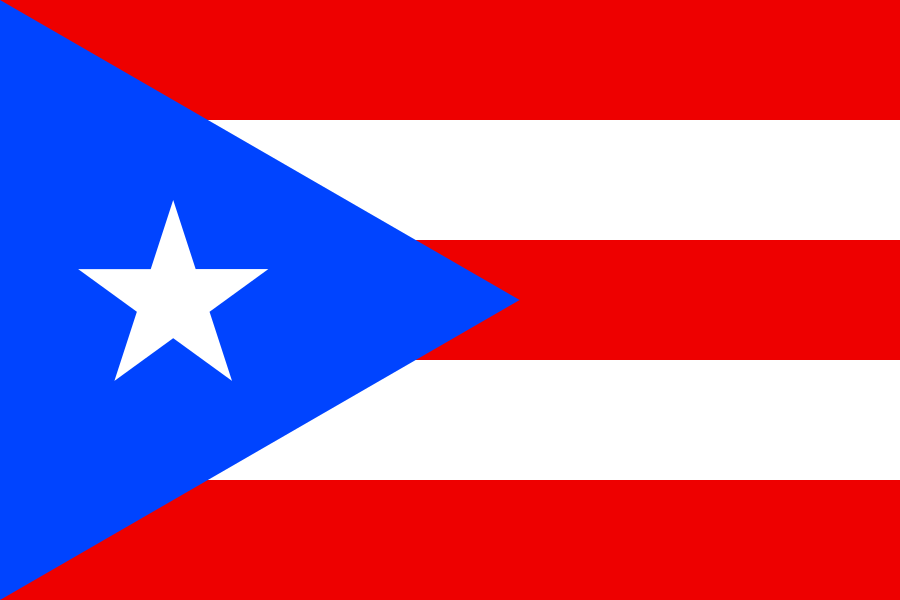
Puerto Rico
Moving to and from Puerto Rico
Household goods moving between the mainland and Puerto Rico make no customs entry. The island sits inside the customs territory of the United States, and a US citizen travelling directly from Puerto Rico doesn't need a passport. But each direction has its own checks. Leave the island and APHIS, the federal plant and animal inspection service, inspects every passenger bag, with federal rules making cargo bound for the mainland subject to agricultural inspection. Move onto it, and the island's plant law bars soil brought in without a permit. Send a car on its own, and Hacienda, the island's Treasury, collects its excise before you can take the car home.
Star Van Lines moves households in both directions, and the shipment crosses by sea. We pick up your goods on the island when you're leaving it and deliver to your address there when you're moving in. On the mainland, our road leg runs under USDOT #4176875 and MC #1607491, and every move starts with a survey and a written estimate.
A move between Puerto Rico and the mainland is a domestic move with an ocean crossing in the middle, so household goods make no customs entry. What you do face is agricultural inspection on the way out, and Hacienda's taxes and the island's driver's licence rules on the way in. Knowing which rule belongs to which direction saves you time.
Survey and written estimate start with a call to (855) 822-2722. Star Van Lines has worked across the 50 states since 2016 and has 240+ reviews on public platforms.

Dennis has 15+ years of experience in interstate moving and has coordinated over 1,000 relocations across the United States.
Moving services between Puerto Rico and the mainland
As movers for both directions, we take households from the mainland to Puerto Rico and from the island to the US mainland. Every move starts with a survey and a written estimate, the goods cross by sea, and on the island we either pick them up or deliver them to your address, depending on which way you're going.
Moving to Puerto Rico from the mainland
Shipping household goods to Puerto Rico starts the way any long move does: with a survey, at home or by video, that measures the shipment in cubic feet. And that volume goes into a written estimate. When your goods are loaded, each item goes on the inventory with its value. Our road leg on the mainland runs under USDOT #4176875 and MC #1607491, which you can check on the public SAFER registry. Then the shipment crosses by sea, and we deliver it to your address on the island. If that address isn't ready when we load, the goods stay where we picked them up until you confirm it. Puerto Rico's own plant law applies to what arrives, so read the section on soil and plants before loading day.
Packing up a home in Florida or New York? Our Florida and New York moving pages cover the mainland end of the trip.
Moving from Puerto Rico to the US mainland
Here the order flips. We pick up your household goods on the island, they cross by sea, and the road leg finishes the job on the mainland. But federal agricultural rules apply to what leaves Puerto Rico, from fruit and plants to soil and some foods, so the section below on inspections is worth reading before you pack. And those rules reach the bags you fly with as well as the shipment. If your mainland address isn't settled yet, we hold your goods where we picked them up until you confirm it, and storage is priced by volume. That way nobody has to sign a lease in a hurry just to receive the furniture.
How long does a Puerto Rico move take?
We don't give a number of days, because the crossing runs on a schedule we don't control. What we put in writing is the estimate, and our mainland road leg runs under a licence you can check. Hurricane season, covered further down, is worth weighing when you choose your dates.
How much does a Puerto Rico move cost?
The cost of a move between Puerto Rico and the mainland depends on the volume of your shipment and where on the mainland it starts or ends. No flat rate applies to Puerto Rico moves. Each move is priced after a survey and set out in a written estimate.
What drives a Puerto Rico move's cost?
- Volume. Furniture, boxes and appliances all count toward the cubic feet measured at the survey.
- The mainland end. A load from New York and a load from California make two different road legs, and the same goes for a move that ends in either state.
- Packing, if you'd like it done for you at a mainland pickup (packing and unpacking).
- Storage, if your address isn't ready, priced by volume like the move.
Do you pay island tax on your belongings?
That's for Hacienda to decide, and Hacienda collects it, not us. The IVU is Puerto Rico's own sales and use tax, not a customs duty, and it applies to articles brought in for use on the island. Hacienda's return applies 10.5% to items imported for use plus the 1% municipal tax, and goods arriving by sea pay it before release. Section 4030.09 of Puerto Rico's Internal Revenue Code lets a non-resident who intends to establish residence bring in used taxable items that reasonably form part of the move free of that tax. Whether yours qualify is Hacienda's call. A private person importing goods for their own use declares them on Modelo SC 2970 through Hacienda's SURI system.
How does the estimate start?
Our line, (855) 822-2722, answers from 08:00 to 20:00, seven days a week. From there we arrange a survey, and the estimate comes to you in writing. If the mainland end sits far inland, the long-distance moving page covers that stretch of road.
Puerto Rico moves: what you should know
Puerto Rico is inside the customs territory of the United States, so household goods don't go through customs in either direction. What you do meet are agricultural rules: APHIS checks what leaves the island, and Puerto Rico's own plant law covers what arrives. And cars, pets and driver's licences each come with their own paperwork, so plan them early.
Do you go through customs?
Not with your household goods. Under 19 CFR 101.1, the customs territory of the United States takes in only the states, the District of Columbia and Puerto Rico. CBP says US citizens travelling directly from Puerto Rico don't need to present a passport. CBP adds that having proof of citizenship or lawful permanent residence on hand helps it expedite customs processing for travellers leaving US territories for the mainland. And the Census Bureau and CBP classify shipments between the mainland and Puerto Rico as domestic.
What gets inspected leaving Puerto Rico?
APHIS inspects every passenger bag bound for the mainland at the airport before departure. Under 7 CFR 318.13-8, persons, baggage, cargo and other articles moving from Puerto Rico to elsewhere in the United States are subject to agricultural inspection. Cargo carrying fruits, vegetables or other regulated articles can't be presented to or loaded by a carrier unless it has been inspected, passed and stamped, or holds a limited permit, under 7 CFR 318.13-10. The simplest course is to leave fresh produce, plants and soil out of the household shipment.
Some things have to stay behind. APHIS keeps out cactus, flowering plants in the citrus family and plants in soil, along with soil itself, sugarcane, live insects, land snails and handicrafts made from palm fronds. And it prohibits or restricts most fresh fruits and vegetables and certain plants, flowers included. Commercially canned and thoroughly cooked foods are generally allowed, though everything permissible is still inspected. But pork is the exception: in baggage, only commercially canned pork and labelled, shelf-stable baked goods containing pork may travel, so chicharrones don't. Leaving an agricultural item undeclared can mean delays and civil penalties of $100 to $1,000 per violation. The full lists sit on APHIS's Puerto Rico page.
Mail gets the same treatment. APHIS wants allowed agricultural items mailed or shipped from Puerto Rico to the mainland inspected or certified before they go to the post office or a courier.
One current note: APHIS order DA-2026-37 of September 28, 2026 set up a Mediterranean fruit fly quarantine in Old San Juan, together with the Puerto Rico Department of Agriculture. Packing up in Old San Juan? Ask APHIS whether the quarantine touches anything you plan to take.
What rules apply arriving on the island?
Puerto Rico's Plant Health Act, Law 93 of 1973, bars bringing in soil, earth, sand or similar material from outside Puerto Rico without a permit from the Secretary of Agriculture. The same law lets the Secretary intercept and inspect plants, plant products and other articles that can carry plant pests when they come from any US state, territory or district, and open baggage or packages that may hold them. Because of that, garden soil and potted plants are the items to think about before loading.
Shipping a car separately
Vehicles aren't part of our moves to or from the island: we move household goods. If you're sending a car on its own, these are the agency rules to know.
Arriving in Puerto Rico, the excise, or arbitrio, is paid through Hacienda's SURI system before you take possession, and SURI also gives an estimate by VIN. Under Ley 22-2000, the car generally can't leave the docks until you present the title, a used car is inspected before DTOP, the island's transportation department, authorizes its licence, and no car is registered until the excise is paid. A privately used car from a state whose owner doesn't live in Puerto Rico can get a special permit for up to 120 days in any 12-month period.
A used car going either way also needs Electronic Export Information filed with its VIN before it departs, whatever its value. That holds even though CBP says a used car going from the continental United States to Puerto Rico isn't an export under 19 CFR 192.2. And the car can still be inspected.
Bringing a dog or cat
Moving a dog or cat to Puerto Rico doesn't need an import permit from the Puerto Rico Department of Agriculture. It does need an official certificate of veterinary inspection from an accredited veterinarian in the state of origin, valid for 30 days from the inspection, stating the animal didn't come from an area quarantined for rabies. Dogs and cats over four months old must have had a rabies shot within six months before shipment, with the certificate. Treatment for external parasites has to happen within 72 hours before entry and appear on the health certificate. Each animal needs official identification too: a microchip or a collar with a metal ID tag. Heading the other way, APHIS doesn't regulate pets moving with their owners between states, so the receiving state or territory sets the rules.
Switching to a Puerto Rico licence
A valid licence from a US state exempts its holder from Puerto Rico's licence requirement only for the first 180 days after arriving, under Article 3.05 of Ley 22-2000. That rule covers state licences issued under the federal REAL ID Act of 2005. DTOP lists full reciprocity with US states and territories on its form DTOP-DIS-257: with a valid licence there's no exam, while an expired one means taking both exams. You'll bring a medical certification on form DTOP-DIS-260 from a physician authorized in Puerto Rico, no more than six months old, and a driving record from your state issued within 30 days. DTOP keeps your old licence. As of October 2026, CESCO, DTOP's driver service centre, lists the fees as a $15 internal revenue stamp, a $1 stamp and a $2 voucher, plus $17 if you want REAL ID validation.
Puerto Rico by the numbers
0,184,835
Population, July 1, 2025
0,737
San Juan Municipio population, July 1, 2025
-0,686
Population change, July 2024 to July 2025
0.5% + 1% municipal
Tax on items imported for use
June 0 to November 30
Atlantic hurricane season, 2026
0.9 °F
San Juan normal annual mean temperature (1991-2020)
The Census Bureau's Vintage 2025 estimates put Puerto Rico's population at 3,184,835 on July 1, 2025, down 17,686 in a year. San Juan Municipio had 329,737 people on the same date. The 2026 Atlantic hurricane season runs from June 1 to November 30, and San Juan's normal annual mean temperature is 80.9 °F.
Is Puerto Rico a good place to live?
Whether Puerto Rico works for your family comes down to language and climate, since the paperwork stays domestic. Spanish and English are both official languages of the government, San Juan's climate normals run warm and wet, and the 2026 Atlantic hurricane season runs from June 1 to November 30.
Spanish, English or both?
Both. Puerto Rico's Official Languages Act, Law 1 of January 28, 1993, makes Spanish and English official languages of the government, usable interchangeably. So you can use either one with government offices, from DTOP to Hacienda, and pick whichever you're more comfortable in.
What is San Juan weather like?
The National Weather Service in San Juan gives 1991-2020 normals of 80.9 °F for the annual mean temperature, with an average daily high of 86.7 °F and a low of 75.1 °F. Annual precipitation averages 59.87 inches. Pack for heat and rain rather than winter.
When does hurricane season run?
NOAA puts the 2026 Atlantic hurricane season at June 1 to November 30, and NOAA's National Hurricane Center counts the Caribbean Sea as part of the Atlantic basin. On its 1991-2020 record, an average season brings 14 named storms, 7 hurricanes and 3 major hurricanes. If your dates are flexible, weigh the season when you pick them.
Does mail count as domestic?
Yes. The US Postal Service's Domestic Mail Manual lists Puerto Rico among the territories that domestic mail runs between, so letters and parcels to and from the mainland travel as domestic mail. Plants and produce are the exception, and the inspection section above explains what APHIS asks for first.
Is Puerto Rico's population growing?
No. The Census Bureau's Vintage 2025 estimates show a drop of 17,686 residents between July 2024 and July 2025, leaving 3,184,835 people on the island.
Ready to talk dates? Pick up the phone: (855) 822-2722 gets you a survey and a written estimate in either direction. Tell us which way you're moving, and we'll build the estimate around it. The mainland road leg runs on our federal numbers, USDOT #4176875 and MC #1607491. For moves to other countries, start with our international moving page.
Questions? Look here
Your household goods don't. Puerto Rico is part of the customs territory of the United States under 19 CFR 101.1, and the Census Bureau and CBP classify mainland-island shipments as domestic. US citizens travelling directly from the island don't need a passport, though CBP says proof of citizenship helps.
Yes, in both directions. When you're leaving the island, we pick up your household goods there, they cross by sea, and our road leg on the mainland runs under USDOT #4176875 and MC #1607491. If your new address isn't fixed yet, we hold the goods where we picked them up until you confirm it.
Yes. On a move from the mainland to the island, we deliver your household goods to your address in Puerto Rico. The move starts with a survey that measures the shipment in cubic feet, and the price goes into a written estimate. Call (855) 822-2722 to set it up.
It depends on the volume of your shipment, the mainland end of the route and whether you want packing or storage, which is priced by volume too. No flat rate applies: a survey sets the volume, and the price goes into a written estimate. Call (855) 822-2722 to start.
Mostly not. APHIS keeps out cactus, citrus-family flowering plants, plants in soil, soil itself and sugarcane, and it prohibits or restricts most fresh fruits and vegetables. Commercially canned and thoroughly cooked foods are generally allowed, pork aside, but they are still inspected. Undeclared items can bring penalties of $100 to $1,000 per violation.
Soil needs a permit. Puerto Rico's Plant Health Act bars bringing in soil, earth, sand or similar material without a permit from the Secretary of Agriculture, and lets the Secretary inspect plants and plant products arriving from any state. Leave the garden soil behind and check potted plants before you pack them.
No. Our moves to and from the island cover household goods only. If you send a car separately, Hacienda's excise must be paid before you take possession, the car generally can't leave the docks without its title, and DTOP inspects a used imported car before licensing it.
No import permit is needed. The pet does need a certificate of veterinary inspection valid for 30 days and, if it's over four months old, a rabies vaccination given within six months before shipment. Treat it for external parasites within 72 hours before entry, and make sure it has a microchip or wears a collar with a metal ID tag.
For the first 180 days after you arrive, under Article 3.05 of Ley 22-2000. After that you'll need a Puerto Rico licence. With a valid licence from a state whose licences meet REAL ID, DTOP's reciprocity process asks for no exam. Among the documents are a medical certification and a recent driving record, and DTOP keeps your old licence once you've paid the fees.
June 1 to November 30 in 2026, according to NOAA. On 1991-2020 data, an average Atlantic season, which takes in the Caribbean Sea, brings 14 named storms, 7 hurricanes and 3 major hurricanes. Keep it in mind if your moving dates are flexible.
Hacienda applies IVU to taxable items brought in for use, at 10.5% plus the 1% municipal tax on imports, and goods arriving by sea pay it before release. Section 4030.09 of Puerto Rico's Internal Revenue Code exempts used items that reasonably form part of a move for a non-resident establishing residence. Whether your goods qualify is for Hacienda to decide.
The FMCSA SAFER registry lists both numbers, USDOT #4176875 and MC #1607491, with the USDOT number active and authority to carry household goods. It covers the mainland road leg. Agricultural inspection, Hacienda's taxes and DTOP's licence rules belong to those agencies.
Ready to Start Your Puerto Rico Move?
Get a free moving estimate today. No obligation, no pressure.
Call us or fill out the form - we'll get back to you fast.
USDOT #4176875 | MC #1607491