
Thank you for your feedback!
We will contact you shortly

Free consultation
Enter your phone number and we will call you back for a consultation on any moving and storage services
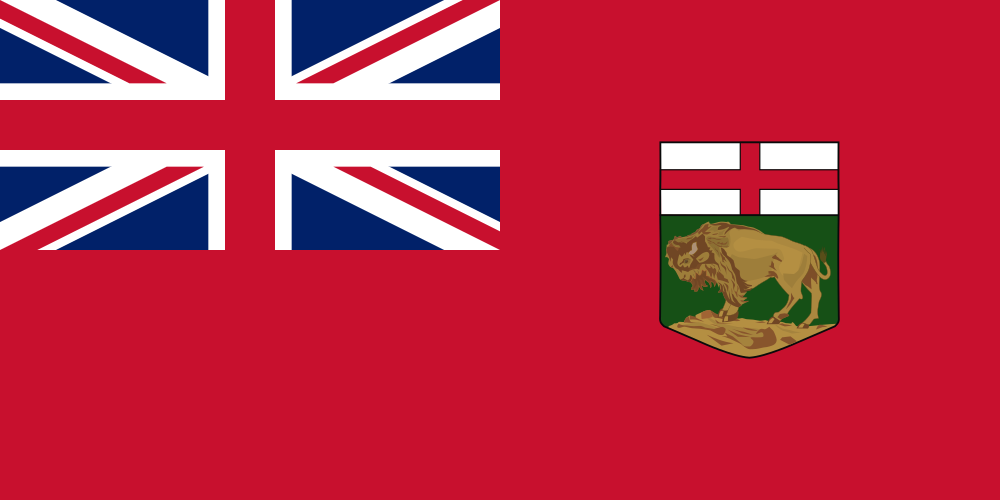
Manitoba
Moving to Manitoba from the US
In Manitoba, the licence in your wallet, the plates on your car and the insurance that car must carry all run through one public insurer, Manitoba Public Insurance, or MPI. New residents have three months, MPI says, to switch to Manitoba plates and to exchange a valid US licence for a Manitoba one. Registration and insurance are bought together, since a vehicle in Manitoba must be both registered and insured. But one rule catches Americans out. MPI doesn't accept a safety inspection certificate from any US state, so a car coming up from the US needs a Certificate of Inspection from a program MPI recognizes.
We move households from the US to Manitoba. Our own federal authority covers the American part of the trip: USDOT #4176875 and MC #1607491. Your home is surveyed in person or by video and the shipment measured in cubic feet. And the price comes as a written estimate built on that volume, not on a guess made over the phone.
Moving to Manitoba from the US means working through three sets of rules: US rules for the road leg, the Canada Border Services Agency (CBSA) at the border, then the province's own. CBSA decides whether you count as a settler, a status that federal regulations don't extend to anyone coming to work for 36 months or less, or to study. And once you're in, Manitoba Health and MPI set the next deadlines.
Call (855) 822-2722 between 08:00 and 20:00, any day, to book a survey. We've moved households since 2016. Over those years the work has reached all 50 states, and public review platforms list 240+ reviews of it.

Dennis has 15+ years of experience in interstate moving and has coordinated over 1,000 relocations across the United States.
Moving services to Manitoba
Star Van Lines takes on household moves from the US to Manitoba. The work covers a survey of your home, a written estimate, an inventory with a value for every item and the US road leg under USDOT #4176875. Past the border, CBSA's settler rules apply, and MPI and Manitoba Health take over after that.
How does a move to Manitoba work?
A survey comes first. Someone walks through your home, in person or on a video call, and measures everything that's going in cubic feet. That volume is what the written estimate rests on.
On loading day each item goes onto an inventory with its value written beside it. That record comes in handy again when you sit down to write the goods list CBSA expects from a settler. And we'll explain what each line of that list is asking for before you fill it in.
The Federal Motor Carrier Safety Administration (FMCSA) issued the authority that the US road leg runs on. The public SAFER registry lets you confirm it yourself: search USDOT #4176875 and you'll find the number active, MC #1607491 on the record and household goods within the authority. Those numbers stop counting at the border. North of it, Canadian agencies make the rules.
Emerson and the other crossings
CBSA's directory shows Emerson, across from Pembina, North Dakota, open 24 hours a day, 7 days a week, to travellers and to commercial traffic. It's also a Designated Commercial Office, which CBSA defines as a port of entry giving round-the-clock service every day of the week for reporting and clearing commercial goods. And it's the only Manitoba crossing on the agency's wait-time list of the busiest land crossings from the US. Emerson sits on Highway 75, which Manitoba's transportation minister called the province's main north-south trade route in 2023, and the provincial government says that highway is twinned all the way to the US border.
But smaller crossings keep shorter commercial hours. Boissevain, opposite Dunseith, North Dakota, handles commercial goods from 09:00 to 17:00 on weekdays, holidays excepted. Sprague, Gretna, South Junction, Winkler and Lyleton are what CBSA calls Non-Terminal Offices, where it doesn't accept electronic release or accounting data for commercial transactions.
Whichever way you travel, you hand your goods list to the officer at your first point of entry, even if your belongings are still on their way. Settlers' effects moving by commercial carrier may be cleared where they first arrive or travel in bond to a designated CBSA office, and CBSA says that office should be contacted beforehand to confirm it can clear them. Winnipeg has an inland office, with commercial hours from 08:00 to 16:00 on weekdays except holidays.
Loading in North Dakota or Minnesota? Our North Dakota and Minnesota pages cover moves from those states.
How long does a Manitoba move take?
Shipments headed for Winnipeg, Brandon or elsewhere in Manitoba are usually delivered within about 30 days of pickup, which is typical rather than promised. There's a border in the middle, and clearance there moves at CBSA's pace, not a mover's.
Can your goods wait for an address?
Yes. If you don't have a Manitoba address yet when your home is packed, we keep your goods where we picked them up until you confirm it. Storage is charged by volume.
How much does moving to Manitoba cost?
What you'll pay to move to Manitoba from the US depends on three things: the volume of your shipment, how far your home is from the border and whether you want packing. There's no flat rate. A survey comes first, then a written estimate, worked out the same way as any other move except for the route.
What moves the price up or down?
- Volume. The survey puts a cubic-foot number on it.
- Your starting point. A shipment loaded in Minnesota has a much shorter US road leg than one loaded in Florida.
- Packing. If you'd rather not pack it all yourself, read about packing and unpacking before pickup.
Which fees come with the car?
Agency charges. They sit outside any moving estimate. The Registrar of Imported Vehicles (RIV) charges a declaration fee of CAN$325.00 plus GST/HST, and the fee applies to cars under 15 years old. Air conditioning adds a CAN$100 excise tax, according to CBSA's vehicle memorandum. In Manitoba the safety inspection has no set price, because each inspection station decides what to charge.
Then the 25% surtax. Customs Notice 25-15 has applied it to US-origin motor vehicles, new or used, since April 9, 2025. But the notice leaves out goods under a Chapter 98 tariff item unless its Schedule 2 names that item, and 9807.00.00, the item for settlers' effects, isn't named. Where CUSMA (Canada-United States-Mexico Agreement) treatment applies to the car, only 85% of its value for duty counts toward the surtax by default. How your car is classified is for CBSA to decide.
How do you book a Manitoba survey?
Pick up the phone. (855) 822-2722 is answered from 08:00 to 20:00 every day of the week, and one call sets the survey date. We put the figure in writing once the survey's done. Starting a long way from the border? Our long-distance moving page covers the domestic stretch.
Moving to Manitoba: what you should know
Most of what happens at the border is federal: CBSA rules on your household goods and your car, the Canadian Food Inspection Agency (CFIA) on pets, and US Customs and Border Protection (CBP) on the car's export. Manitoba's part comes after you arrive, and MPI and Manitoba Health set most of its deadlines.
Our Canada moving guide lays out the federal side for every province.
Do your goods enter Manitoba duty-free?
That depends on whether CBSA treats you as a settler. In customs terms, a settler is someone entering Canada to establish a residence for the first time and planning to keep it for one year or more. The Definition of Settler Regulations leave out anyone arriving to study or to work for 36 months or less. Their goods fall outside the settler rules, so ask CBSA how yours will be handled.
Duty and taxes are waived on a settler's goods as long as you owned, possessed and used them before you got to Canada. Anything you lease is the exception: in CBSA's view it isn't yours, so duty and taxes apply. List everything you're bringing in two copies, giving each item's value and, where it has them, its make, model and serial number. At your first point of entry, the border services officer uses that list to complete Form BSF186, the Personal Effects Accounting Document, and hands you a copy as a receipt. Keep it. You'll need that copy to claim whatever reaches Canada after you. CBSA lets you prepare BSF186 ahead of time, and its moving to Canada page sets out the main conditions. One condition lasts a year. Anything sold or given away within 12 months of import loses its exemption, and the duty and taxes come due.
Customs status and immigration status are separate things. Immigration, Refugees and Citizenship Canada (IRCC) manages the selection, settlement and integration of newcomers, and no moving company has a say in that.
What if some boxes reach Manitoba after you?
Yes, if they were listed. CBSA's name for them is goods to follow. Anything missing from the list you gave the officer at the border loses the duty- and tax-free treatment when it turns up. The Customs Tariff sets no deadline for listed goods, though it's worth confirming the details with CBSA. But alcohol, tobacco and vaping products can't follow at all.
What needs declaring at the Manitoba border?
- Alcohol. Settlers can bring either 1.5 litres of wine or 1.14 litres of any alcoholic beverage, carried with them on arrival. The minimum age is set by the province or territory where you enter Canada: 18 if you cross in Manitoba, Alberta or Quebec, and 19 anywhere else.
- Tobacco. The cap is 50 cigars, 200 cigarettes, 200 tobacco sticks and 200 grams of manufactured tobacco, and none of it can be sent on later. For tobacco the age is 18, the figure CBSA's I Declare page gives for a personal exemption.
- Firearms. All of them go on your declaration to the border services officer. To import a non-restricted firearm as a Canadian resident, you need a Possession and Acquisition Licence.
- Cannabis stays behind: Health Canada says crossing the border with it is illegal, even for medical use.
- Food, plants, firewood, soil. Food, plants and animal products must be declared. Firewood needs a permit, and soil on vehicles, equipment or footwear usually gets them refused.
- Cash. Arriving with CAN$10,000 or more in currency or monetary instruments means a report to CBSA.
From US title to Manitoba plates
The car's paperwork starts in the US. US Customs and Border Protection (CBP) has to receive the export documents at least 72 hours before a used vehicle leaves by road, under 19 CFR 192.2. Electronic Export Information (EEI) must be filed for a used self-propelled vehicle whatever its value, under 15 CFR 30.2. And the filing citation is due to CBP on the same 72-hour clock, under 15 CFR 30.4. A lease or a recorded lien adds written permission from the leasing company or lienholder.
In Canada, a car joins the Registrar of Imported Vehicles (RIV) program if it's less than 15 years old on the import date, isn't flagged inadmissible on the Vehicle Import Compatibility List and has no outstanding safety recalls. It also needs its original US certificate of title. Older cars fall outside RIV, but CBSA's own requirements still apply. The declaration goes on Form 1, the Vehicle Import Form. The RIV inspection has a 45-day window from the date of import; past that, RIV sends the importer of record a delinquent notice. CBSA's vehicle memorandum counts a financed car as yours for settler purposes; a car leased in the US fails that ownership test.
Then MPI. For a car from the US, it wants the CBSA Vehicle Import Form and proof of ownership: for a US purchase, the certificate of title. Any vehicle brought into Manitoba, including one owned by a family moving there, needs a safety Certificate of Inspection. It has to come from Manitoba or from an approved program in British Columbia, Alberta, Saskatchewan, Ontario or Quebec. New residents have three months to get Manitoba registration and insurance for a passenger car or van.
Sales tax is the last piece. A vehicle can come in without the 7% Retail Sales Tax (RST) when you take up residence, provided you lived outside Manitoba for at least 6 consecutive months, bought it at least 30 days before moving in and don't use it commercially. Proof of all three goes to MPI, or to an Autopac agent that handles MPI registrations, when you register.
Do dogs and cats need papers?
Because the CFIA treats the United States as a country not free of rabies, a dog older than 3 months and a cat aged 3 months or more must arrive with a valid rabies vaccination certificate. A vaccination given before the dog was 3 months old doesn't count, by the CFIA's rule. Puppies between 3 and 8 months old travelling alone need a Veterinary Certificate of Health on top of the rabies certificate. No microchip or tattoo is needed for a pet dog or cat.
Does the 2026 surtax apply?
The 2026 surtax took effect on September 8, 2026, under CBSA Customs Notice 26-23. It applies to certain goods of US origin, at 15%, 25% or 50% of their value for duty. Chapters 98 and 99 of the tariff are left out unless Schedule 4 to the Order names the item. And the settlers' effects item, 9807.00.00, doesn't appear in Schedule 4. CBSA decides how your goods are classified, so take any item that might not count as a settler's effect to the agency.
Your first weeks in Manitoba: a checklist
- Apply for Manitoba Health coverage. Canadian citizens and permanent residents moving from outside Canada may apply for health coverage from their date of arrival in Manitoba. Residents then get a health card, or registration certificate, confirming eligibility under The Health Services Insurance Act. The steps are on Manitoba Health's moving to Manitoba page.
- Gather the documents. The application needs a copy of your passport, every IRCC document issued to you, your spouse and your children under 18, and proof that you live in Manitoba.
- Check your permit type. Work permit holders may apply from the date the permit was issued if it runs at least 12 consecutive months. But study permit holders haven't been eligible since September 1, 2018.
- Count your days. Eligibility rests on making your home in Manitoba and being physically there for 183 days in a calendar year.
- Know what isn't covered. Manitoba Health doesn't pay for land ambulance trips to a hospital, and the patient cost is currently CAN$250.
- Exchange your licence at MPI. A valid US licence must be swapped for a Manitoba one within three months. MPI lists a CAN$75 licence fee, keeps the licence you surrender and issues a temporary licence valid for up to 45 days until the permanent one comes by mail. And MPI asks newcomers to bring their driving and insurance records.
- Register and insure the car. Book the Certificate of Inspection, then get Manitoba registration and insurance within three months of becoming a resident.
- Plan for taxes. Manitoba doesn't use the HST: the Canada Revenue Agency lists 5% GST and a separate 7% PST, which Manitoba Finance calls the Retail Sales Tax (RST). Provincial income tax for 2026 starts at 10.8% on the first CAN$47,564 of taxable income, on top of federal tax. Which province's rate applies depends on where you live on December 31, 2026.
What to know before moving to Manitoba
Manitoba by the numbers
0,517,379
Population, July 1, 2026 (preliminary)
0,758
Winnipeg metro area (CMA), July 1, 2025 (preliminary)
Three months
Time to exchange a US licence with MPI, 2026
0% GST + 7% PST
Sales tax, 2026
-0.3 °C
Winnipeg January daily average (1991-2020)
CAN$0,571
Average 2-bedroom rent, Winnipeg metro, October 2025
Statistics Canada's preliminary estimate put Manitoba's population at 1,517,379 on July 1, 2026, and its preliminary estimate for the Winnipeg metro area was 951,758 on July 1, 2025. MPI gives new residents three months to exchange a US licence, and the CRA lists 5% GST plus 7% PST for the province.
Is Manitoba a good place to live?
Life in Manitoba centers on Winnipeg, a metropolitan area of 951,758 people in Statistics Canada's estimate for July 1, 2025, where the average two-bedroom rent was CAN$1,571 in October 2025. Winters are cold, the economy is spread over many industries, and English and French both have official status in the legislature and courts.
What does living in Winnipeg cost?
Housing first. The Canada Mortgage and Housing Corporation (CMHC), in its October 2025 Rental Market Survey, put the average rent for a two-bedroom private apartment in the Winnipeg metro area at CAN$1,571 a month, compared with CAN$1,507 a year earlier. The vacancy rate for private apartments rose to 2.8%, and to 3.0% for two-bedroom units. Outside Winnipeg, the Brandon census agglomeration held 62,723 people on July 1, 2025, by Statistics Canada's estimate.
How cold does Winnipeg get?
Environment and Climate Change Canada's 1991-2020 normals for Winnipeg Richardson Airport give January a daily average of -16.3 °C and July 19.5 °C, and annual snowfall averages 126.2 cm. And Brandon's January is slightly colder, at -16.7 °C.
Is French used in Manitoba?
In law and in some public offices, yes. Section 23 of the Manitoba Act, 1870 gives English and French official status in the legislative and judicial spheres, so provincial statutes and regulations are passed in both languages and the courts must be able to work in either. The government adopted a French Language Services Policy in 1989, and its current policy delivers French services through Bilingual Service Centres in designated areas.
What drives Manitoba's economy?
Variety more than any single industry. Manitoba's Budget 2026 calls the economy diversified, with nine industries each contributing at least five per cent of provincial GDP in 2024. It estimates real GDP growth of 1.6% for 2025, and the forecasts it cites put 2026 at 1.3%, seventh among the provinces, then 1.7% in 2027, with unemployment forecast at 5.8% for 2026. But the United States remains Manitoba's largest export destination, and the budget flags US tariffs as a risk for agriculture and manufacturing.
To plan a move to Winnipeg, Brandon or another Manitoba town, start with a call to (855) 822-2722, and the survey and written estimate follow. USDOT #4176875 and MC #1607491 are the numbers behind the US road leg. For the federal rules, read our Canada moving guide, and for other destinations, the international moving page.
FAQ
Questions? Look here
Can’t find an answer? Call us
(855) 822-2722 or email
Yes. Manitoba Public Insurance says a valid licence from Canada or the United States must be exchanged for a Manitoba licence within three months. MPI lists a CAN$75 licence fee and gives you a temporary licence for up to 45 days while the permanent card is mailed. Ask MPI what your licence class requires.
For Canadian citizens and permanent residents moving from outside Canada, Manitoba Health says you may apply for coverage from the date you arrive in Manitoba. Health coverage from the first day of the third month is the rule for people arriving from another province or territory. Work permit holders may apply from the permit's issue date if it runs 12 consecutive months or more.
It depends on how CBSA sees you and your goods. A settler's goods that were owned, possessed and used before arrival enter free of duty and taxes, though leased goods don't. Federal regulations exclude people coming to work for 36 months or less, or to study. Sell or give something away within 12 months of import and the exemption is lost.
No. MPI takes safety inspection certificates only from government-approved programs in British Columbia, Alberta, Saskatchewan, Ontario and Quebec and calls those from US states unacceptable. Any vehicle brought into Manitoba needs a Certificate of Inspection, cars of people moving there included. The price isn't fixed; each inspection station sets its own.
Yes. CBSA's directory lists the Emerson port of entry, opposite Pembina, North Dakota, as open 24 hours a day, 7 days a week, for travellers and for commercial goods. It's a Designated Commercial Office and the only Manitoba crossing on CBSA's busiest-crossings wait-time list. Hours can change, so check the directory before you set a date.
Not if your car meets the settler conditions in Manitoba Finance's bulletin. A vehicle can come in without the 7% Retail Sales Tax when you take up residence, provided you lived outside Manitoba for at least 6 consecutive months, bought it at least 30 days before moving in and don't use it commercially. Proof goes in at registration.
Yes, with paperwork. Because the US isn't on the CFIA's list of rabies-free countries, a dog older than 3 months or a cat 3 months or older needs a valid rabies vaccination certificate. A young dog under 8 months that crosses without its owner also needs a Veterinary Certificate of Health, and no microchip is required.
That comes down to the cubic-foot volume the survey measures, how far your home is from the border and whether you'd like packing before pickup. Call (855) 822-2722 to arrange the survey, and the estimate comes back in writing rather than as a guess over the phone.
Yes. Star Van Lines serves all 13 provinces and territories, Manitoba among them, and runs the US road leg under USDOT #4176875 and MC #1607491. Canadian rules then apply north of the border. Book a survey on (855) 822-2722 and you'll get the estimate in writing.
On the FMCSA SAFER registry, which lists USDOT #4176875 as active, shows MC #1607491 on the same record and names household goods in the authority. That authority stops at the border. In Canada, CBSA, MPI and Manitoba Health set the rules.
Ready to Start Your Manitoba Move?
Get a free moving estimate today. No obligation, no pressure.
Call us or fill out the form - we'll get back to you fast.
USDOT #4176875 | MC #1607491