
Thank you for your feedback!
We will contact you shortly

Free consultation
Enter your phone number and we will call you back for a consultation on any moving and storage services
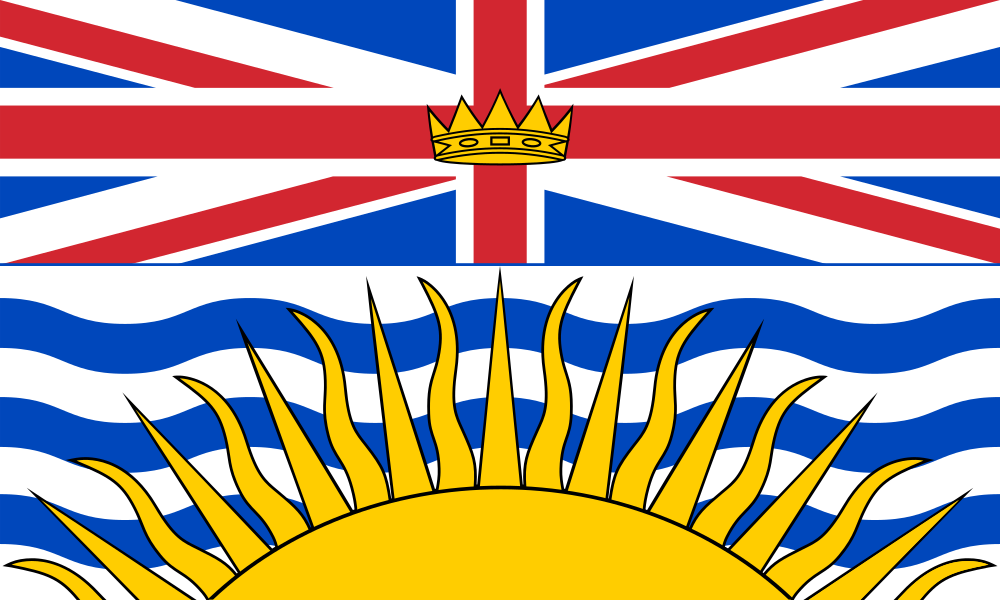
British Columbia
Moving to British Columbia from the US
The first months in British Columbia cost more than the estimate for the truck. Provincial health coverage doesn't start at the border: the Ministry of Health says a new resident may become eligible for the Medical Services Plan after a wait made up of the balance of the month in which residence is established, plus two months. And the province's advice for that gap is blunt. Arrange private insurance before you land, because most private insurers won't cover a pre-existing condition.
Rent and tax land in the same window. Star Van Lines keeps the American road leg under our own federal operating authority: USDOT #4176875, MC #1607491. The survey happens in your home or over video, the shipment is measured in cubic feet, and that number goes into a written estimate. What follows is the border agency's side of a B.C. move, what the province's sales tax does to what you bring, and what you'll want lined up early.
Moving to Vancouver from the US, or to anywhere else in British Columbia, is a household move with a customs entry in the middle. You list what you're importing, declare it to the Canada Border Services Agency as a settler, then work through MSP enrolment, an ICBC licence swap and vehicle registration on the far side. Paperwork sets the pace here, not mileage.
Need a number for British Columbia? Call (855) 822-2722 and we'll set up the survey. Star Van Lines has been moving households across all 50 states since 2016, and the public review history now runs past 240.

Dennis has 15+ years of experience in interstate moving and has coordinated over 1,000 relocations across the United States.
Moving services to British Columbia
A move to British Columbia from the US runs on two sets of rules. The road leg inside the United States travels under a federal moving authority that anyone can look up. Past the border, the Canada Border Services Agency decides what your household goods need at entry. You'll want to plan for both from day one.
How does a US-to-B.C. move work?
It starts with a survey of the home you're leaving, in person or over video. The shipment is measured in cubic feet, and it's that volume the written estimate rests on, rather than a guess made over the phone. At loading everything is inventoried and valued, item by item.
You keep a copy of it. And it lists much of what CBSA will want to see on a list of your own: everything you're bringing, with values, makes, models and serial numbers where they exist. It's worth keeping our inventory open beside you while you write that one. And we'll go through the paperwork with you: what Canada asks a settler to produce, and what to have ready when you reach the crossing.
That American leg runs on our FMCSA authority, USDOT #4176875 and MC #1607491. Both numbers sit on the SAFER registry for anyone to check. The operating authority there reads as authorized for household goods, and the USDOT status as active. Those lines are what a mover's licence looks like from the outside. They're good for the road inside the United States. But they stop at the border, where Canada's rules take over.
British Columbia is one of 13 destinations for us: we serve every province and territory, by sea where no road reaches a community, as our Canada moving guide explains.
Which crossings connect Washington and B.C.?
Thirty of Canada's busiest land crossings from the United States get published wait times from CBSA, with commercial and traveller flows counted apart. Five of those ports open on the B.C. side of the line:
- Pacific Highway, Surrey, BC, across from Blaine, Washington, with a commercial flow.
- Douglas, also Surrey to Blaine, where the commercial column reads Not Applicable.
- Abbotsford-Huntingdon, across from Sumas, Washington.
- Aldergrove, across from Lynden, Washington.
- Boundary Bay, Delta, BC, across from Point Roberts, Washington.
Those times move around, so read the agency's page on the day rather than the week before. Loading in Washington? All five face that state, though Point Roberts, opposite Boundary Bay, is a US exclave reachable from the rest of Washington only through Canada. Either way your own declaration happens at your first point of entry in Canada. Start in Montana or further east and the American road leg gets longer.
How long does a move to B.C. take?
Most moves are delivered within about 30 days of pickup. Typical rather than promised: a border and two sets of agencies stand between the American road leg and your new address. You also get the written estimate, plus a road leg in the US under a licence that's public.
Still waiting on a British Columbia address?
Then the shipment stays where we loaded it until you confirm the address, and storage there is priced by volume.
How much does moving to British Columbia cost?
What a move to British Columbia costs depends on how much you ship and where the load starts. There's no flat Canada rate on this site. Every move is priced after a survey and set down in writing, so the figure follows your own volume and your own starting point rather than a phone estimate.
What changes the price of a B.C. move?
- Volume. Cubic feet, counted room by room at the survey.
- Where it starts. A load from Seattle and a load from Texas are different American road legs.
- Packing. Rather not wrap it all yourself? That's our packing and unpacking service.
A car brings import costs of its own, and they aren't ours to charge. For a vehicle less than 15 years old the Registrar of Imported Vehicles charges CAN$325.00 plus GST/HST, and a vehicle with an air conditioning unit owes a CAN$100 excise tax on top of that.
How do we put the estimate in writing?
Call (855) 822-2722. Someone picks up seven days a week, 08:00 to 20:00. We set the survey, measure the load and put the estimate in writing. And if the move starts a long way inland, our long-distance moving page explains how the domestic road leg is handled.
Moving to British Columbia: what you should know
A settler, in the border agency's language, is someone entering Canada to establish a residence for the first time, for a year or more. Settlers may bring personal and household goods in without duty or taxes once CBSA's conditions are met. People coming to work for 36 months or less, or to study, fall under different rules.
Settlers' effects and the BSF186 form
The goods have to have been owned, possessed and used abroad before you arrive, or they don't come in free of duty and taxes. Leased goods are out of it, since CBSA doesn't treat you as their owner.
Two copies of your list travel with you. Value, make, model, serial number where those apply. Hand it to the border services officer at your first point of entry, even if the shipment is still on the road. The officer completes Form BSF186, the Personal Effects Accounting Document, and your copy claims the goods that turn up later. The form can be filled in before you arrive, CBSA says, which speeds up clearance. Full rules sit on CBSA's moving to Canada page.
And one condition catches people out. Sell an imported item, or give it away, inside the first year after importation, and the duty and taxes you were spared fall due.
What does a goods to follow list do?
It keeps the exemption alive for whatever lands after you. Goods arriving later come in free of duty and taxes only when they appeared on the list you handed over at entry, and CBSA's settlers' effects memorandum, D2-2-1, says no time limit applies to goods listed to follow. Alcohol and tobacco run the other way: under the tariff they count only when they travel with you on arrival. Put any timing question to CBSA.
Does PST apply to what you bring?
B.C.'s provincial sales tax is generally 7%, and the Ministry of Finance says it reaches goods brought into B.C. for use there, unless a specific exemption applies. New residents have an exemption of their own. Bulletin PST 306 sets the conditions: the goods are for non-business use, they enter B.C. within one year of the day you become a resident, and you have owned them for a continuous period of at least 30 days before you import them. Corporations aren't eligible. Take your own case to the Ministry of Finance before assuming the whole inventory is covered.
Which items need extra care at the border?
- Alcohol and tobacco. A settler may include wine up to 1.5 litres, or other alcoholic beverages up to 1.14 litres, plus set tobacco quantities, but only among goods accompanying you on arrival. The minimum import age follows the province of entry: 19 at a B.C. crossing. CBSA separately says you must be 18 to bring tobacco or vaping products into Canada under a personal exemption.
- Firearms. Declare every firearm to a border services officer, and expect a minimum age of 18 to import one. A visitor can't bring in prohibited firearms, devices or weapons under any circumstances, while a Canadian resident needs a Possession and Acquisition Licence for non-restricted ones.
- Cannabis. Taking it across the border is illegal, Health Canada says, and that covers cannabis used for medical purposes.
- Food, plants, firewood, soil. Food, plants and animal products all get declared. Firewood needs a permit. And goods carrying soil are usually refused, while a used mattress needs a certificate that it was cleaned and fumigated in the country of export, unless it comes in as settlers' effects.
- Cash. Currency or monetary instruments of CAN$10,000 or more get reported on arrival.
Bringing your car into B.C.
Start on the American side. Two US rules set that clock, 19 CFR 192.2 and 15 CFR 30.4: the export documents and the Electronic Export Information filing citation reach US Customs and Border Protection at least 72 hours before a used self-propelled vehicle leaves by road, and the car is presented at export. A leased car, or one carrying a recorded lien, also needs a letter from the third party that expressly allows the export. RIV suggests getting documents to CBP at least 3 business days ahead.
Federal conditions come next. A vehicle in the RIV program has to be less than 15 years old on the date of importation, clear of the Vehicle Import Compatibility List and free of outstanding manufacturer safety recalls, with its original US certificate of title. The declaration goes on Transport Canada's Vehicle Import Form, known as Form 1, and a delinquent notice follows when the inspection isn't completed within 45 days from the date of import. A leased car fails the settler ownership test. A financed one doesn't, though a settler's vehicle may not be sold for up to 12 months after arrival.
Then the province. ICBC says you have 30 days to register, license and insure your vehicle after arriving in B.C., and immediately for a commercial one. Vehicles registered outside B.C. get inspected at a B.C. designated inspection facility, with exemptions such as new vehicles, motorcycles and vehicles with a net weight of 3,501 kg or more, so it's worth asking an Autoplan broker which one fits yours. And one car never qualifies at all: ICBC says a vehicle damaged in a flood can't be licensed or insured in B.C.
Pets at the border: dogs and cats
The Canadian Food Inspection Agency doesn't count the United States among rabies-free countries. So a valid rabies vaccination certificate travels with a dog older than 3 months, and with a cat of 3 months or older. Send a dog older than 3 months but under 8 months without its owner and a Veterinary Certificate of Health is needed too. Dogs must have been at least 3 months old when vaccinated. Canada asks for neither a microchip nor a tattoo on a personal pet dog or cat.
What about the 2026 surtax on US goods?
Since September 8, 2026, certain goods originating in the US have carried a surtax of 15%, 25% or 50% of the value for duty. Chapters 98 and 99 of the tariff are exempt unless the tariff item appears in Schedule 4 to the Order, and settlers' effects, tariff item 9807.00.00, isn't listed there. Read that way, qualifying settlers' effects fall under the Chapter 98 exception. But confirm it with CBSA, above all for anything that doesn't qualify.
Your first weeks in B.C.: a checklist
- Apply for MSP on arrival. Every B.C. resident has to enrol in the Medical Services Plan. The Ministry of Health counts a resident as a citizen of Canada, or a person lawfully admitted to Canada for permanent residence, who makes their home in B.C. and is physically present at least six months in a calendar year; some holders of work or study permits valid six months or more may also count. Steps sit on the province's MSP enrolment page.
- Budget for the wait. For people new to Canada the province puts coverage at about three months after the arrival date, and the Ministry of Health, not you, decides the residency date for MSP purposes. Contact a private insurer first: care received before MSP starts is paid in full unless other insurance applies.
- Collect the B.C. Services Card. Most adults finish enrolment at an ICBC driver licensing office, and the Personal Health Number is printed on the card.
- Switch the licence inside 90 days. That's what ICBC gives you after a move here from another country, to trade a valid licence for a B.C. one.
- Ask ICBC about testing. Knowledge and road testing are waived for passenger and motorcycle licences from most US states. But most isn't all, so confirm your own. And expect to surrender the licences you hold: only one is legal here.
- Send in your driving record. ICBC credits up to 15 years of driving experience for insurance purposes once it has an acceptable record.
- Register the vehicle inside 30 days. The designated-facility inspection comes with it.
- Reckon on two taxes. The CRA lists 5% GST and 7% PST for British Columbia, and B.C.'s lowest personal income tax rate for the 2026 tax year is 5.60% on taxable income from CAN$0 to CAN$50,363. Budget 2026 paused bracket indexation for the 2027 to 2030 tax years.
- Read IRCC's pages yourself. Immigration, Refugees and Citizenship Canada runs the permanent residence programs, Express Entry and family sponsorship among them, plus a work permit page for people who mean to work in Canada for a few years.
What to know before moving to British Columbia
British Columbia by the numbers
0,646,420
Population, April 1, 2026
0,642,825
Vancouver metro population, 2021 Census
0% GST + 7% PST
Sales tax
0.60%
Lowest provincial income tax rate, 2026
0.1 °C
Vancouver airport January daily average (1991-2020)
CAN$0,363
Average 2-bedroom rent, Vancouver metro primary rental market, Oct. 2025
Statistics Canada estimated British Columbia's population at 5,646,420 on April 1, 2026, and the Vancouver metro area alone held 2,642,825 at the 2021 Census. Sources for the cards below: Statistics Canada, CMHC, Environment and Climate Change Canada, the CRA and B.C.'s own Ministry of Finance. Each card carries its period, so nothing here is averaged across years.
Is British Columbia a good place to live?
Whether British Columbia suits your household comes down to rent, weather and work rather than scenery. A two-bedroom apartment in the Vancouver area averaged CAN$2,363 a month in October 2025, the airport records a January that barely freezes, and the federal government calls the port down the road the largest in the country.
What does a Vancouver apartment rent for?
CMHC's October 2025 Rental Market Survey put the average rent for a two-bedroom private apartment in the Vancouver CMA at CAN$2,363 a month. The same survey found the private apartment vacancy rate, across all bedroom types, at 3.7%, up from 1.6% in October 2024. So there's more room to choose than renters had a year earlier. But the rent still sets the tone of those first months. It's the number people underestimate before the move, and it falls inside the same window as the MSP wait. Two costs, one stretch of calendar.
How mild are Vancouver winters, really?
Mild, by the standards of the country you're moving into. Environment and Climate Change Canada's 1991-2020 normals for Vancouver International Airport give a January daily average of 4.1 °C, 36.6 cm of snowfall in a year and 1,159.5 mm of precipitation. So the winter you're packing for is rain. Keep the waterproof layer near the top of the box, and tape the bottoms twice: cardboard that has never met humidity is about to.
Is B.C.'s population still growing?
Not at the moment. BC Stats reported the province down 12,108 people, or 0.2%, in the first quarter of 2026, and down 53,270, or 0.9%, over the previous 12 months, driven mainly by reduced international migration. But the interprovincial column ran the other way: a net inflow of 1,581 people in the same quarter, a fourth consecutive quarter of gains. Statistics Canada's estimate for April 1, 2026 was 5,646,420. Read together, those lines point in two directions at once: fewer arrivals from abroad, more from the rest of Canada.
What does the Port of Vancouver move?
The Government of Canada describes it as Canada's largest port, moving a billion dollars in goods every day and handling 40% of Canada's trade in goods beyond North America, with a record year in 2025. Does that change your packing list? Not one box. But it says something about the economy you're arriving in.
Ready to put dates on it? Call (855) 822-2722, and the survey and the written estimate follow from there. We walk the rooms, count the cubic feet and put the figure in writing before you commit to anything. The American road leg runs under USDOT #4176875 and MC #1607491, and the international moving page covers the ocean side of what we do.
FAQ
Questions? Look here
Can’t find an answer? Call us
(855) 822-2722 or email
Not if the goods qualify as settlers' effects under the tariff. CBSA says they must have been owned, possessed and used abroad before you arrive to come in free of duty and taxes. Leased goods don't qualify, since CBSA doesn't treat you as their owner, and anything sold or given away inside the first year after importation becomes subject to the duty and taxes that were waived.
That's CBSA's Personal Effects Accounting Document. You bring two copies of a list of your goods, with value, make, model and serial number where they apply, and the border services officer completes Form BSF186 from that list at your first point of entry. Your copy is what claims goods that arrive later. CBSA says it can also be completed before you arrive.
Yes, provided it was on the list you gave the border services officer when you first entered Canada. Goods that follow come in free of duty and taxes only if they appeared on that original list, and CBSA's settlers' effects memorandum says no time limit applies to them. Alcohol and tobacco are the exception: under the tariff they count only when they accompany you on arrival.
The Ministry of Health says a new resident may be eligible after a wait period made up of the balance of the month in which residence is established, plus two months. For people new to Canada the province says coverage may start about three months after the arrival date. It advises arranging private health insurance before arrival and keeping it until MSP begins, noting most private insurers don't cover pre-existing conditions.
B.C.'s PST is generally 7% and reaches goods brought into the province for use unless a specific exemption applies. Bulletin PST 306 gives new residents an exemption where the goods are for non-business use, enter B.C. within one year of the day you become a resident, and have been owned for a continuous period of at least 30 days before importation. Corporations aren't eligible.
ICBC says that after moving here from another country you have 90 days to switch a valid licence for a B.C. driver's licence. Testing is waived for passenger and motorcycle licences from most US states, which isn't the same as all of them, so confirm your own state with ICBC. Proof of at least two years of driving experience exempts you from the Graduated Licensing Program.
ICBC says you have 30 days to register, license and insure a vehicle after arriving in B.C., and commercial vehicles must be done immediately. A vehicle registered outside B.C. has to be inspected at a B.C. designated inspection facility, with exemptions such as new vehicles, motorcycles and vehicles of 3,501 kg or more. Before any of that, the federal RIV program applies to a car less than 15 years old.
Yes. The CFIA doesn't treat the United States as rabies-free, so a dog older than 3 months and a cat of 3 months or older each need a valid rabies vaccination certificate, and dogs must have been at least 3 months old when vaccinated. A dog older than 3 months but under 8 months travelling without its owner also needs a Veterinary Certificate of Health. Neither a microchip nor a tattoo is asked for.
It depends on the volume of your shipment in cubic feet, where the move starts and whether you want the packing done for you. There's no flat Canada rate to quote. Call (855) 822-2722 and the survey comes first, the written estimate after it. Vehicle import charges, such as the Registrar of Imported Vehicles fee of CAN$325.00 plus GST/HST for a vehicle less than 15 years old, sit outside that figure.
USDOT #4176875 and MC #1607491, both on the FMCSA SAFER registry, where the operating authority reads as authorized for household goods. That federal authority covers the US road leg. It doesn't extend past the border, where the Canada Border Services Agency and B.C.'s own agencies set the rules for entry and for settling in.
Ready to Start Your British Columbia Move?
Get a free moving estimate today. No obligation, no pressure.
Call us or fill out the form - we'll get back to you fast.